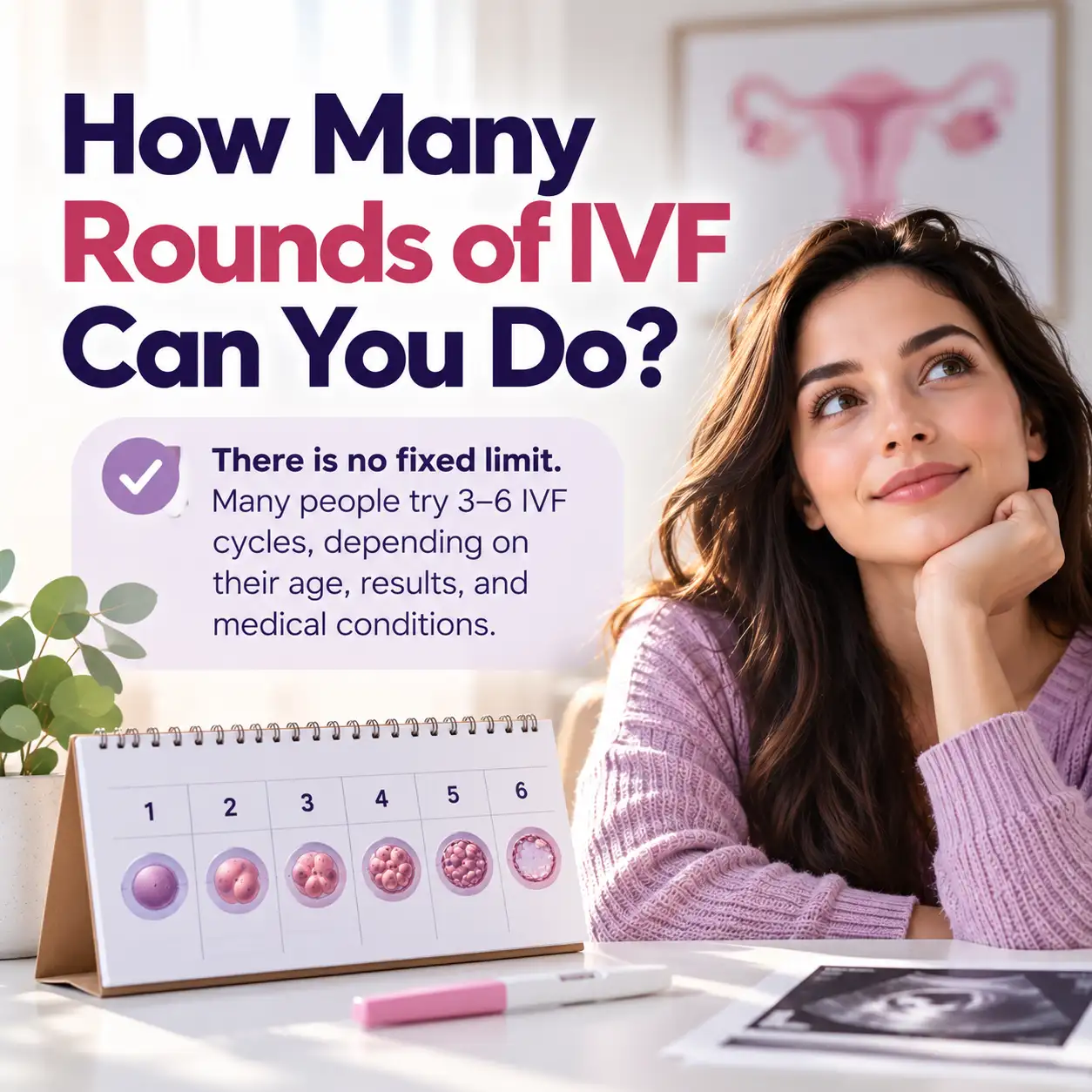
There is no fixed number of IVF rounds that everyone must stop at. Some people have a baby after one cycle; others need several attempts. For many patients, three to six complete IVF cycles is a reasonable range to discuss with a fertility specialist, but age, previous results and the expected benefit of another attempt matter more than the number alone.
The research offers a clearer picture of what repeated treatment can achieve, and why the answer is different for each patient.
Is There a Limit to How Many Times You Can Do IVF?
No universal medical rule sets a maximum number of IVF cycles. A specialist may recommend continuing if another attempt has a reasonable chance of success and the treatment remains medically appropriate. In other cases, it may make more sense to change the approach or consider alternatives.
What happened during previous cycles is important. Someone who produced several embryos but had unsuccessful transfers has a different treatment history from someone who retrieved very few eggs or did not obtain an embryo suitable for transfer.
That is why a failed cycle should lead to a review of the results, not simply another round with the same plan.
How Many IVF Cycles Does It Take to Have a Baby?
Two large studies help answer this question, although their estimates are not directly interchangeable.
A 2015 study published in JAMA followed 156,947 women receiving IVF in the UK. The researchers estimated a cumulative live-birth rate of 65.3% by the sixth cycle after adjusting for the prognosis of women who stopped treatment. Among women younger than 40 using their own eggs, the adjusted estimate was 68.4%.
A separate 2016 study in The BMJ, involving 113,873 women using their own eggs and their partner’s sperm, found that 43% had a live birth within six complete cycles in the observed treatment data. Its model estimated a 46% chance after one complete cycle and 79% after three for a 30-year-old woman with two years of unexplained infertility.
Why are the figures different? The studies used different methods to estimate cumulative success, including how they handled patients who discontinued treatment. The BMJ estimate for a specific patient also depends on the characteristics entered into its model.
Neither study means that every patient has the same chance of success. They do show that the chance of a live birth can rise across repeated attempts, although the size of that benefit varies.
How Many IVF Cycles Can You Have in One Year?
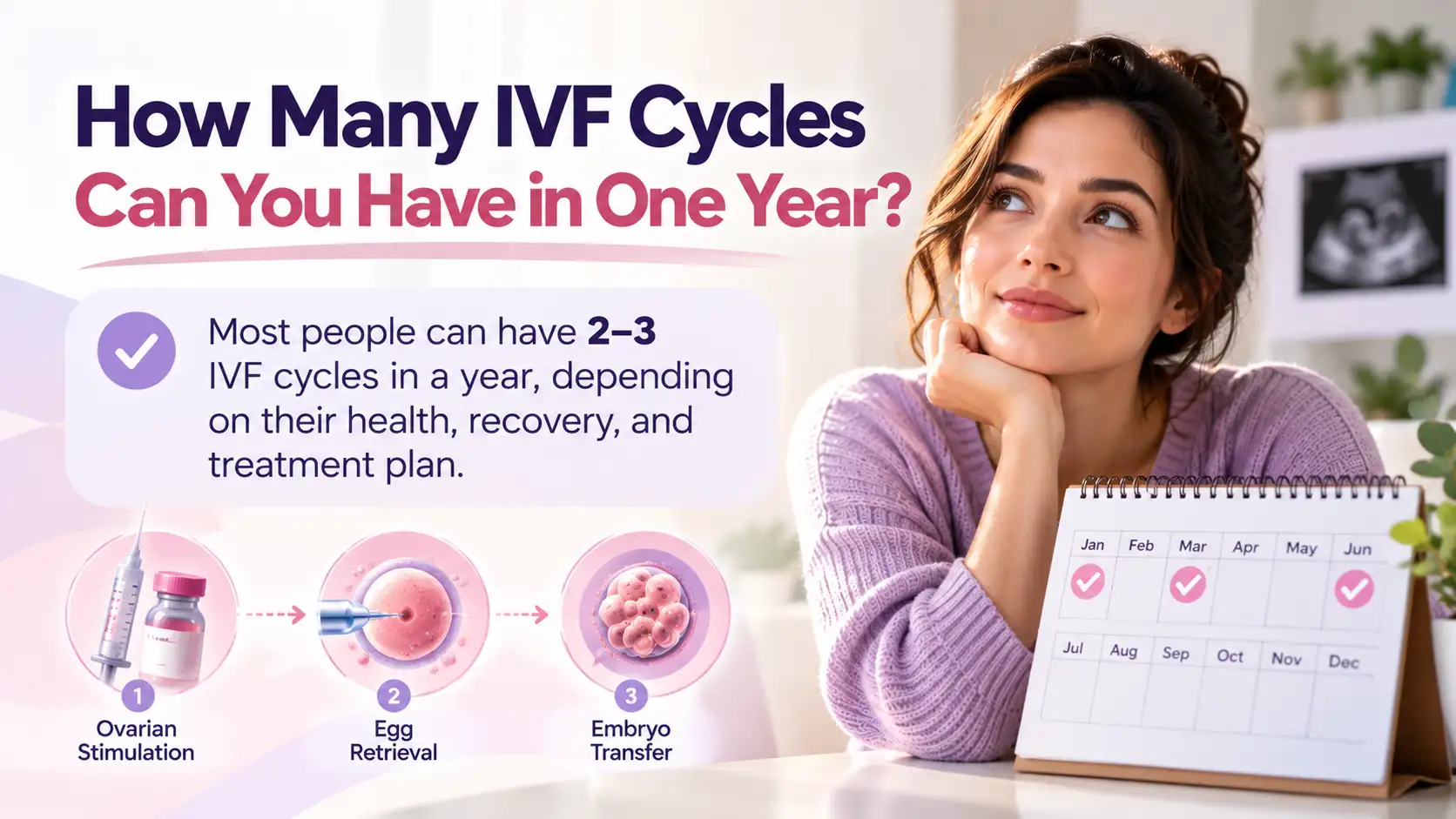
Some patients can complete two or three egg-retrieval cycles within a year. Selected treatment plans may involve more, but there is no standard number that is safe or suitable for everyone.
A stimulated IVF cycle includes medication to develop multiple follicles and a procedure to collect the eggs. After an unsuccessful attempt, a clinic may be able to start another stimulation cycle after the next menstrual period, often around four to six weeks later. The timing depends on recovery and the results of the previous cycle.
Frozen embryo transfers follow a different schedule. If embryos are already stored, a patient may be able to have a transfer without repeating ovarian stimulation and egg retrieval. Several transfer attempts can therefore follow one egg-retrieval cycle.
How Long Should You Wait Between IVF Rounds?
For many patients, another IVF attempt can begin after the next menstrual period, often around four to six weeks later. But there is no single waiting period that applies to everyone. The timing depends on whether you need another egg retrieval or a frozen embryo transfer, how your body responded to treatment, and whether any complications need attention.
Research offers useful guidance on frozen embryo transfer. A 2023 systematic review and meta-analysis included 19 studies and 23,022 frozen embryo transfer cycles. It found no statistically significant difference in live-birth rates between transfers performed sooner and those delayed by at least one menstrual cycle. Most included studies were observational, so the findings do not establish that every patient should follow the same schedule. Read the review.
In practical terms, waiting several extra months does not appear to improve live-birth rates for everyone undergoing frozen embryo transfer. Your clinic may still recommend a delay if your uterine lining needs preparation, your hormone levels require monitoring, or you are recovering from a complication.
Recommended Waiting Time Between IVF Treatments
Treatment or Situation
Typical Timing
What Determines the Timing?
Another stimulated IVF cycle
Often after the next menstrual period, around 4–6 weeks
Ovarian recovery, hormone levels, treatment response and clinic protocol
Frozen embryo transfer (FET)
May be possible in the first menstrual cycle after egg retrieval
Uterine lining preparation, hormone levels and medical readiness
After ovarian hyperstimulation syndrome (OHSS)
Wait until the condition has resolved and your fertility team confirms it is safe
Severity of symptoms, recovery and follow-up assessment
After another complication or an abnormal result
Individualized; a longer delay may be necessary
The complication, additional tests and any treatment required
If your previous cycle was unsuccessful, ask your specialist two questions: Am I medically ready to try again, and is there a clinical reason to wait longer? The answers can help you avoid unnecessary delays without rushing into treatment before you have recovered.
What Determines How Many IVF Attempts You May Need?
The number of IVF attempts needed to achieve a live birth varies from person to person. Research has identified several factors that help predict treatment outcomes, although none can determine exactly how many cycles an individual will need.
Age at egg retrieval: Female age is one of the strongest predictors of fertility. The American Society for Reproductive Medicine (ASRM) identifies age as the single most important predictor of fecundity. As age increases, the likelihood of success with a patient’s own eggs generally declines.
Ovarian reserve and response to stimulation: Tests such as anti-Müllerian hormone (AMH) and antral follicle count (AFC) help estimate how the ovaries may respond to stimulation. The number of eggs retrieved also provides useful information about the potential number of embryos available. However, a low ovarian reserve result does not, by itself, mean that pregnancy is impossible.
Embryo development and quality: The number of embryos that develop and their assessed quality can help clinicians estimate the prospects of treatment. A 2025 systematic review of eight observational studies covering 40,490 IVF/ICSI cycles identified the number of high-quality embryos as an important factor associated with success. Embryo quality is informative, but it cannot guarantee implantation or live birth.
The cause of infertility and other clinical findings: Infertility may involve ovulatory disorders, uterine or tubal conditions, sperm-related factors, or a combination of causes. ASRM recommends evaluating both partners when applicable and tailoring investigations to the medical history and clinical findings. These results can influence treatment choices and whether further evaluation is appropriate before another cycle.
When Should You Reconsider IVF After Failed Cycles?
After an unsuccessful cycle, ask your fertility specialist to review the results before deciding what comes next. Focus on the parts of treatment that may explain the outcome:
How many eggs were retrieved and how many were mature?
How many fertilized and developed into embryos?
Were embryos available for transfer or freezing?
What does the cycle reveal about the likely benefit of another attempt?
Would changing the protocol or investigating a specific problem alter the plan?
Repeated failures do not automatically mean that IVF cannot work. They do, however, make a careful review increasingly important. Continuing treatment should have a clear rationale, rather than being based only on the hope that another identical cycle will produce a different result.
1
Sometimes. A new stimulation cycle may begin after the next menstrual period if your recovery and test results allow it. The clinic should first assess any complications and confirm that another cycle is appropriate.
2
Many patients undergo more than one cycle, but each attempt requires an individual assessment. Risks such as OHSS, the burden of medication and procedures, and the emotional and financial demands of treatment all matter when planning repeated cycles.
3
A frozen embryo transfer is a separate procedure, but it is not necessarily a new complete IVF cycle. A complete cycle is often defined in research as one episode of ovarian stimulation and the fresh and frozen transfers arising from it. Check how a study defines a cycle before comparing its success rates with another source.
4
Not automatically. Your age, previous response, available embryos and estimated chance of success should guide the decision. A review after three unsuccessful attempts can be a useful point to discuss whether to continue, adjust treatment or consider other options, but it is not a universal stopping rule.
The Bottom Line
You may be able to undergo more than three or four rounds of IVF, provided your medical circumstances support continuing. Research shows that cumulative live-birth chances can rise over multiple complete cycles, but the figures vary with patient characteristics and the method used to calculate success.
After an unsuccessful attempt, the most useful question is not simply how many rounds remain. It is what the previous cycle has taught your fertility team, and whether another attempt offers a worthwhile chance of having a baby.