legal surrogacy countries: A Comprehensive Guide

Surrogacy Laws by Country
Author mehdisabet
Reading time 19 min
Published at 13 January 2025

Navigating the complexities of Surrogacy Laws by Country can be challenging, as regulations differ dramatically worldwide. What’s permitted in one nation might be strictly prohibited in another. These laws determine who can utilize surrogacy, the processes involved, and the rights granted to intended parents.

This guide is here to explain how surrogacy is handled around the world. We’ll talk about countries where it’s legal, where it has restrictions, and where it’s completely forbidden. Whether you’re planning to become a parent through surrogacy, thinking about being a surrogate, or just curious about surrogacy legality worldwide, this article is for you

We’ll talk about key legal surrogacy countries, like the United States, Canada, Ukraine, and Iran, and explain their rules, who can join, and the challenges you might face. Our goal is to share clear information to help you make smart choices about surrogacy.

Table of Contents | legal surrogacy countries

Global Surrogacy Laws

An interactive map showing surrogacy regulations worldwide

About This Map

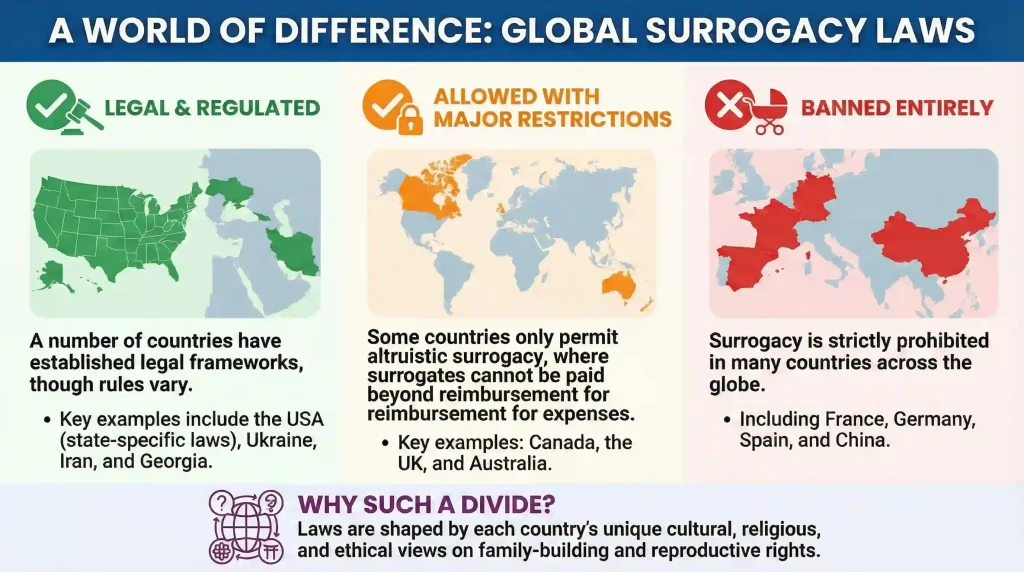
This interactive map provides a comprehensive overview of surrogacy laws around the world. Countries are color-coded based on their legal stance on surrogacy practices, helping you understand the global landscape of surrogacy regulations at a glance.

legal surrogacy countries: Surrogacy is legally permitted and regulated in these countries, with established frameworks governing the process.
Restricted: Surrogacy is allowed with significant limitations or restrictions, such as permitting only altruistic surrogacy or limiting eligibility.
Illegal: Surrogacy arrangements are prohibited by law in these countries, with potential legal consequences for participants.
Unregulated: Countries where surrogacy is neither explicitly legal nor illegal, or where information about regulations is limited.

Map Legend

Legal
Restricted
Illegal
Unregulated

Surrogacy Cost in Legal Countries

Click the link below to learn more about surrogacy costs in legal countries!

Why Do Surrogacy Laws Vary So Much Between Countries?

Surrogacy laws differ greatly between countries due to a combination of cultural, religious, ethical, and legal factors. Each country has its own approach to family-building, influenced by traditions, societal values, and beliefs about reproductive rights. In some places, surrogacy is seen as a compassionate way to help people become parents, while in others, it’s viewed with more caution or restriction due to concerns about exploitation, the commercialization of reproduction, or the impact on society.

Religious beliefs also play a significant role in shaping surrogacy laws, particularly in countries where religious law is integrated into the legal system. For example, some countries may allow surrogacy only under certain conditions that align with religious teachings, while others may prohibit it altogether.

Political stability, economic factors, and the overall legal environment also contribute to how surrogacy is regulated. Countries with more stable legal systems might have clearer laws, while others may still be developing frameworks for emerging technologies like assisted reproduction.

Because surrogacy involves complex emotional, ethical, and legal issues, countries approach it differently based on their unique values and circumstances.

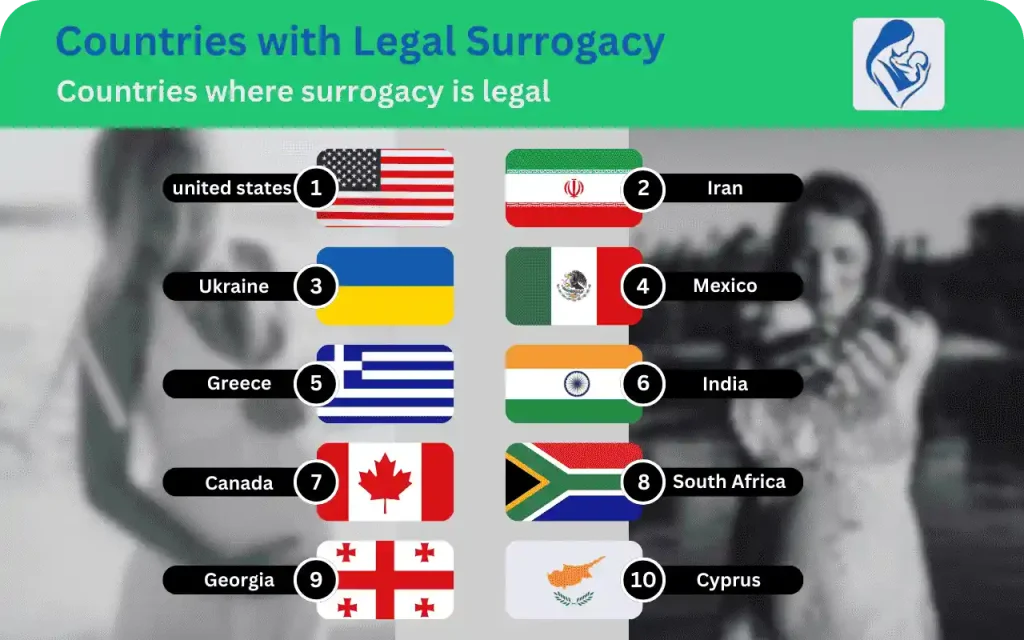
This image lists countries where surrogacy is legal, featuring flags and names of the top ten countries. The countries are ranked from 1 to 10, with the United States at the top, followed by Iran, Ukraine, Mexico, Greece, India, Canada, South Africa, Georgia, and Cyprus.
list of countries where surrogacy is legal

Countries Where Surrogacy is Legal

Below is a list of surrogacy countries legal under specific conditions. In the following sections, we will explore the regulations and legal frameworks governing surrogacy in each of these countries:

In conclusion, understanding the regulations and legal frameworks governing surrogacy is essential for intended parents considering this path to parenthood. The list of countries where surrogacy is legal offers a range of options, each with its own unique conditions and processes. Whether you are looking for financial considerations, legal protections, or ethical practices, it’s important to research and select the country that best fits your needs and expectations for this life-changing journey.

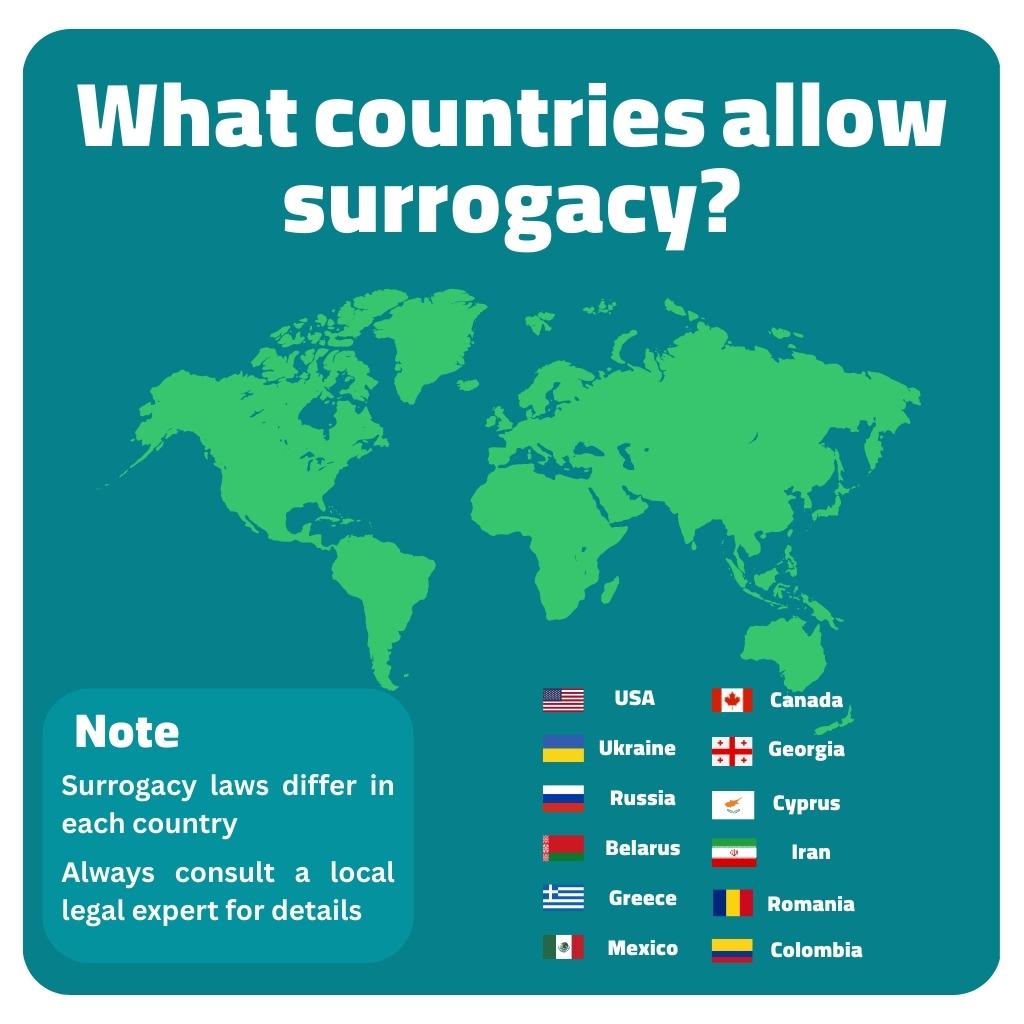
What countries allow surrogacyUnited States Canada Ukraine Georgia Russia Belarus Greece Cyprus Iran Mexico (only Tabasco & Sinaloa) Romania Colombia Title at the top “What countries allow surrogay

What countries allow surrogacy?

Surrogacy is legally permitted in several countries around the world, each with its own specific regulations and frameworks governing the practice. The countries where surrogacy is allowed include the United States, Canada, Ukraine, Georgia, Russia, Belarus, Greece, Cyprus, Iran, and Mexico—though in Mexico, it is only legal in specific states such as Tabasco and Sinaloa. Additionally, Romania and Colombia also recognize and permit surrogacy. Intended parents considering surrogacy in these countries should be aware of the varying surrogacy legality and consult with local experts to navigate the legal requirements effectively.

The countries that allow surrogacy offer different legal frameworks tailored to meet diverse needs. To ensure a smooth and successful journey, it’s crucial for intended parents to work with legal professionals who can guide them through the specific regulations and help them make informed decisions.

surrogacy laws by country

Countries Where Surrogacy is Restricted

Surrogacy is permitted only under certain conditions or with specific limitations in the following countries:


Countries Where Surrogacy is Restricted

CountryFlagCountryFlagCountryFlagCountryFlagCountryFlag
ArgentinaArgentina FlagArmeniaArmenia FlagAustraliaAustralia FlagChileChile FlagChinaChina Flag
EstoniaEstonia FlagIndiaIndia FlagIrelandIreland FlagJapanJapan FlagKazakhstanKazakhstan Flag
KyrgyzstanKyrgyzstan FlagMalaysiaMalaysia FlagMaltaMalta FlagMexico (Specific States: Mexico City, Jalisco)Mexico FlagMongoliaMongolia Flag
NetherlandsNetherlands FlagNew ZealandNew Zealand FlagNorth MacedoniaNorth Macedonia FlagSingaporeSingapore FlagSouth AfricaSouth Africa Flag
ThailandThailand FlagUnited KingdomUnited Kingdom Flag      


Countries Where Surrogacy is Illegal

In this section, we list all the countries where surrogacy is illegal, with the names of the countries presented in alphabetical order. For individuals living in regions where surrogacy is prohibited, surrogacy in other countries provides a viable alternative, allowing intended parents to pursue parenthood in countries where the process is legal and regulated. You can easily find the answer to the question, “What countries is surrogacy illegal?” in this list. We apologize if the list is somewhat lengthy and may not have the most user-friendly structure.

Countries Where Surrogacy is Completely Illegal

Country Flag Country Flag Country Flag Country Flag Country Flag
Afghanistan Afghanistan Flag Albania Albania Flag Algeria Algeria Flag Andorra Andorra Flag Angola Angola Flag
Antigua and Barbuda Antigua and Barbuda Flag Austria Austria Flag Azerbaijan Azerbaijan Flag Bahamas Bahamas Flag Bahrain Bahrain Flag
Bangladesh Bangladesh Flag Barbados Barbados Flag Belgium Belgium Flag Belize Belize Flag Benin Benin Flag
Bhutan Bhutan Flag Bolivia Bolivia Flag Bosnia and Herzegovina Bosnia and Herzegovina Flag Botswana Botswana Flag Brunei Brunei Flag
Burkina Faso Burkina Faso Flag Burundi Burundi Flag Cambodia Cambodia Flag Cameroon Cameroon Flag Cape Verde (Cabo Verde) Cape Verde Flag
Central African Republic Central African Republic Flag Chad Chad Flag China China Flag Comoros Comoros Flag Costa Rica Costa Rica Flag
Croatia Croatia Flag Cuba Cuba Flag Denmark Denmark Flag Djibouti Djibouti Flag Dominica Dominica Flag
Dominican Republic Dominican Republic Flag Ecuador Ecuador Flag Egypt Egypt Flag El Salvador El Salvador Flag Equatorial Guinea Equatorial Guinea Flag
Eritrea Eritrea Flag Eswatini Eswatini Flag Ethiopia Ethiopia Flag Fiji Fiji Flag Finland Finland Flag
France France Flag Gabon Gabon Flag Gambia Gambia Flag Germany Germany Flag Ghana Ghana Flag
Grenada Grenada Flag Guatemala Guatemala Flag Guinea Guinea Flag Guinea-Bissau Guinea-Bissau Flag Guyana Guyana Flag
Haiti Haiti Flag Honduras Honduras Flag Hungary Hungary Flag Iceland Iceland Flag Indonesia Indonesia Flag
Iraq Iraq Flag Ivory Coast (Côte d'Ivoire) Ivory Coast Flag Jamaica Jamaica Flag Jordan Jordan Flag Kenya Kenya Flag
Kiribati Kiribati Flag Kuwait Kuwait Flag Laos Laos Flag Latvia Latvia Flag Lebanon Lebanon Flag
Lesotho Lesotho Flag Liberia Liberia Flag Libya Libya Flag Liechtenstein Liechtenstein Flag Lithuania Lithuania Flag
Luxembourg Luxembourg Flag Madagascar Madagascar Flag Malawi Malawi Flag Malaysia Malaysia Flag Maldives Maldives Flag
Mali Mali Flag Marshall Islands Marshall Islands Flag Mauritania Mauritania Flag Mauritius Mauritius Flag Micronesia Micronesia Flag
Monaco Monaco Flag Montenegro Montenegro Flag Morocco Morocco Flag Mozambique Mozambique Flag Myanmar Myanmar Flag
Namibia Namibia Flag Nauru Nauru Flag Nepal Nepal Flag Netherlands Netherlands Flag New Zealand New Zealand Flag
Nicaragua Nicaragua Flag Niger Niger Flag Nigeria Nigeria Flag North Korea North Korea Flag Norway Norway Flag
Oman Oman Flag Pakistan Pakistan Flag Palau Palau Flag Palestine Palestine Flag Panama Panama Flag
Papua New Guinea Papua New Guinea Flag Paraguay Paraguay Flag Peru Peru Flag Philippines Philippines Flag Poland Poland Flag
Portugal Portugal Flag Rwanda Rwanda Flag Saint Kitts and Nevis Saint Kitts and Nevis Flag Saint Lucia Saint Lucia Flag Saint Martin Saint Martin Flag
Saint Vincent and the Grenadines Saint Vincent and the Grenadines Flag Samoa Samoa Flag São Tomé and Príncipe São Tomé and Príncipe Flag Saudi Arabia Saudi Arabia Flag Senegal Senegal Flag
Seychelles Seychelles Flag Sierra Leone Sierra Leone Flag Slovakia Slovakia Flag Slovenia Slovenia Flag Solomon Islands Solomon Islands Flag
Somalia Somalia Flag South Korea South Korea Flag South Sudan South Sudan Flag Spain Spain Flag Sudan Sudan Flag
Suriname Suriname Flag Sweden Sweden Flag Switzerland Switzerland Flag Syria Syria Flag Tajikistan Tajikistan Flag
Tanzania Tanzania Flag Timor-Leste (East Timor) Timor-Leste Flag Togo Togo Flag Tonga Tonga Flag Trinidad and Tobago Trinidad and Tobago Flag
Tunisia Tunisia Flag Turkey Turkey Flag Turkmenistan Turkmenistan Flag Tuvalu Tuvalu Flag Uganda Uganda Flag
United Arab Emirates United Arab Emirates Flag Uruguay Uruguay Flag Uzbekistan Uzbekistan Flag Vanuatu Vanuatu Flag Vatican Vatican Flag
Venezuela Venezuela Flag Vietnam Vietnam Flag Yemen Yemen Flag Zambia Zambia Flag Zimbabwe Zimbabwe Flag

In conclusion, the list above highlights the countries where surrogacy is illegal, providing valuable insight for those seeking to understand the global landscape of surrogacy laws. If you’ve been wondering what countries is surrogacy illegal, this list answers that question, helping you make informed decisions as you consider your options. It’s important to stay updated on these regulations, as laws surrounding surrogacy can change over time and may vary depending on specific regions within some countries.

Uzbekistan surrogacy law

Uzbekistan surrogacy law

In Uzbekistan, surrogacy is not explicitly regulated or prohibited, creating a legal gray area. While it is not illegal, there are no specific laws governing the practice, so parties should draft agreements carefully with legal counsel to protect everyone’s interests.

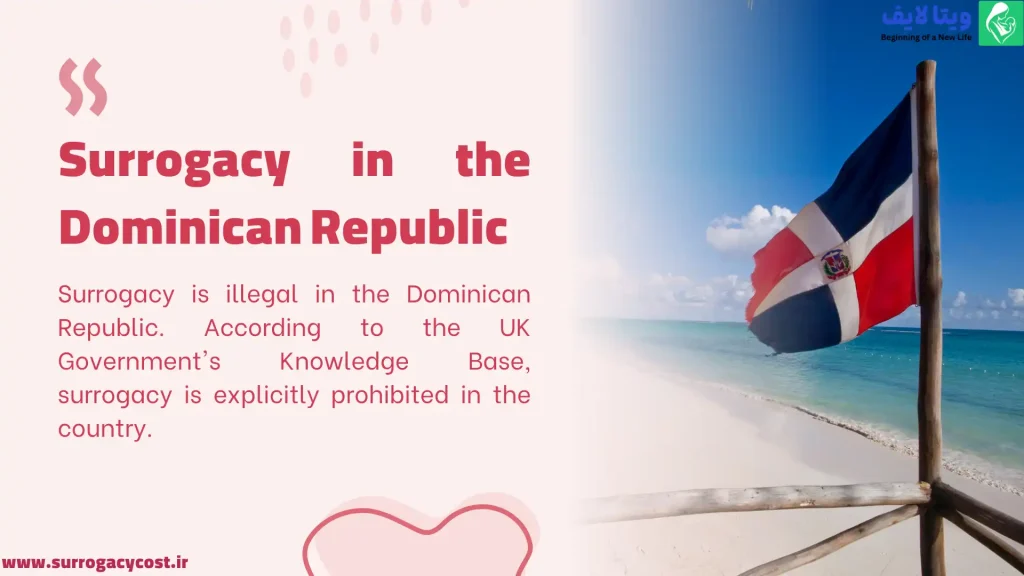
Is surrogacy legal in the Dominican Republic?

is surrogacy legal in dominican republic

Surrogacy is illegal in the Dominican Republic. According to the UK Government’s Knowledge Base, surrogacy is explicitly prohibited in the country

romania surrogacy law

Romania surrogacy law

Surrogacy in Romania exists in a legal gray area: it is neither explicitly legal nor illegal. Romanian law does not provide specific regulations or frameworks for surrogacy arrangements.

surrogacy Albanian

surrogacy albanien

Surrogacy in Albania is briefly referenced in the Family Code and Law No. 8876 on Reproductive Health, but there are no formal regulations or established procedures governing it.

In this article, we’ve divided the countries of the world into three groups: countries where surrogacy is legal, countries with limited laws on surrogacy, and countries where surrogacy is illegal. In the following sections, we’ll give you a complete overview of the rules and regulations in countries where surrogacy is allowed, so you can review the legal situation in each one.

Infographic about surrogacy legality in the US, featuring a city skyline and text.

Surrogacy law in the United States

In the United States, surrogacy laws vary significantly from state to state, creating a complex legal landscape. While some states have clear laws supporting surrogacy arrangements, others rely on common law, and a few impose restrictions or penalties on certain types of surrogacy. Unlike some legal surrogacy countries with nationwide regulations, the U.S. follows a state-by-state system, making legal guidance essential.

A crucial point to note is that where the surrogate lives, where the birth takes place, and where the contract is signed can significantly impact the legal outcome. These factors play a key role in determining parental rights and the overall legal process. (See more: surrogacy laws by state)

States that are considered surrogacy-friendly often support both commercial and altruistic surrogacy contracts, providing clear legal pathways for intended parents to establish their parental rights, sometimes even before the child is born. While some states limit surrogacy support to married heterosexual couples, others extend these rights to unmarried and same-sex couples. In general, gestational surrogacy is more widely accepted than traditional surrogacy, which has limited legal support.

Notable surrogacy-friendly states include CaliforniaIllinois, New York, Maryland, and Washington D.C. These states have well-established legal frameworks, making surrogacy accessible to both domestic and international intended parents. Recent legislative changes, such as the Child-Parent Security Act in New York (effective February 15, 2021), have further strengthened protections for all parties involved in surrogacy arrangements.

For intended parents in states with restrictive surrogacy laws, it’s still possible to work with surrogates in more surrogacy-friendly states. However, it’s crucial to remember that the surrogate’s location, the contract’s execution site, and the place of birth all play a decisive role in determining the legal outcome. For those considering surrogacy abroad, researching legal surrogacy countries with more uniform regulations can provide additional options for a smoother process.

Due to the diverse surrogacy legality in the United States, intended parents must seek legal advice to navigate state-specific surrogacy laws and ensure their parental rights are properly secured.

For a more in-depth look at surrogacy in the USA: laws, costs, and affordable options, visit Surrogacy in the USA: The Ultimate Guide to Laws, Costs, and Affordable Options.

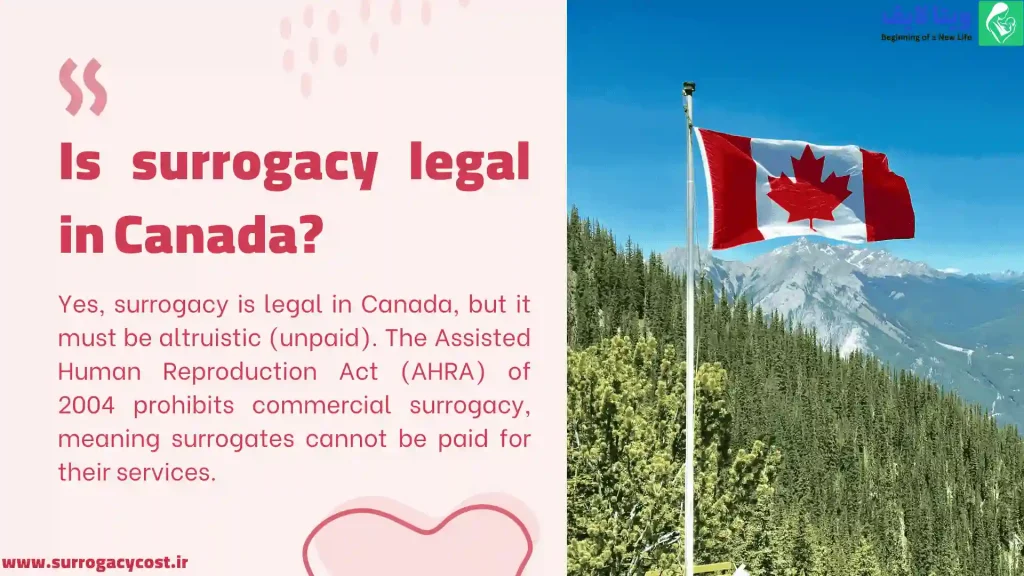
Infographic about surrogacy legality in Canada, featuring the Canadian flag and text.
is surrogacy legal in canada?

Surrogacy Law in Canada

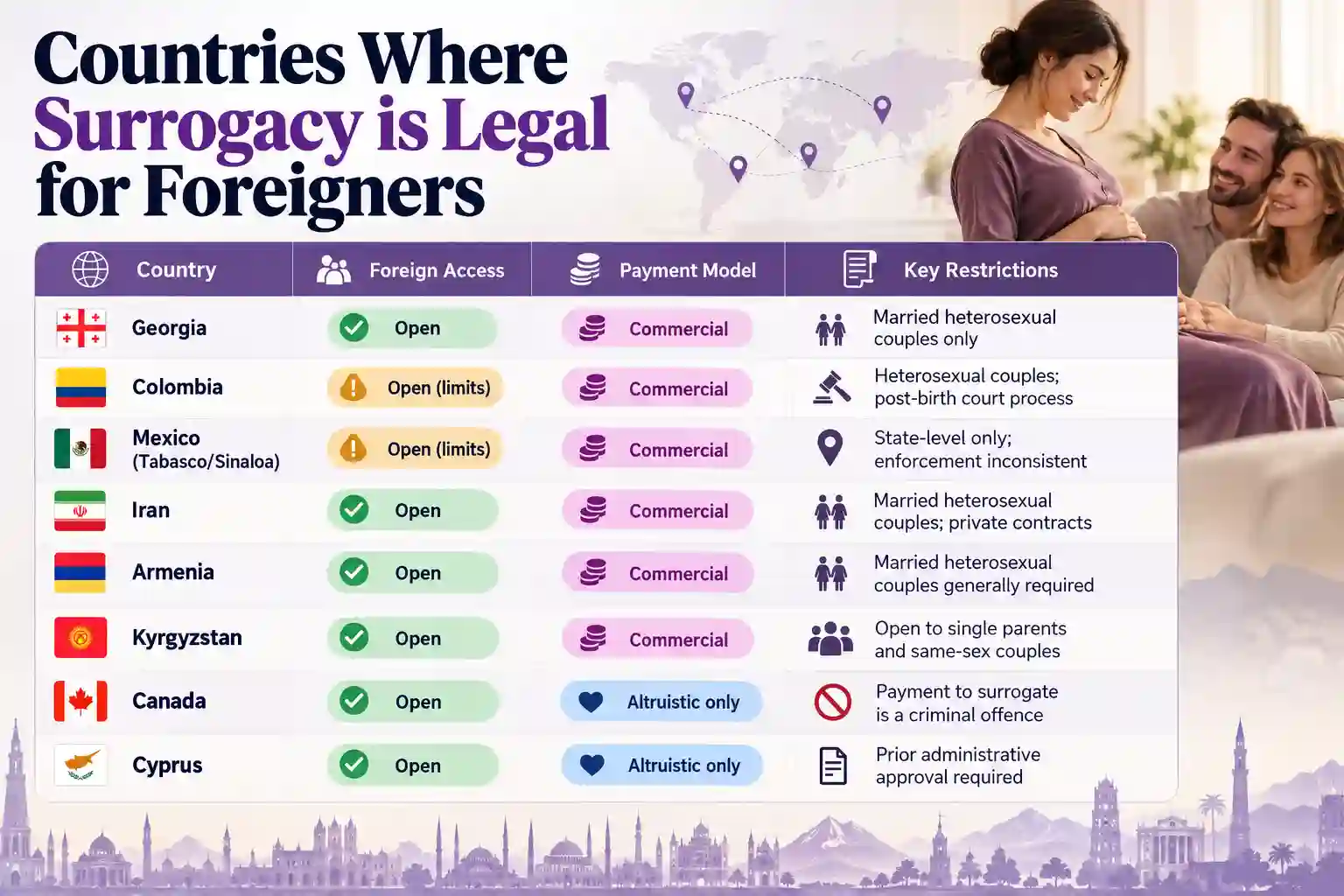
In Canada, surrogacy is governed by the Assisted Human Reproduction Act (AHRA), which permits only altruistic surrogacy. While surrogates can be reimbursed for reasonable, pre-approved expenses directly related to the pregnancy—such as medical costs, maternity clothing, or travel expenses—commercial surrogacy is illegal. This means offering or receiving any payment beyond these approved expenses is strictly prohibited.

While surrogacy is meant to be an altruistic act, it’s important to note that there are specific legal requirements regarding the reimbursement of expenses that must be met. All parties involved in the surrogacy agreement should document these expenses carefully and consult legal experts to ensure compliance with the law.

Although the laws are the same across Canada, some provinces may have additional procedural requirements or nuances in how surrogacy agreements are handled. Compared to other legal surrogacy countries with more flexible regulations, Canada’s strict laws emphasize the altruistic nature of surrogacy. Therefore, it is highly recommended to consult a local legal expert when considering surrogacy in Canada.

Infographic about surrogacy legality in Ukraine, featuring the Ukrainian flag and text.
Is surrogacy still legal in Ukraine?

Surrogacy Law in Ukraine

Ukraine has long been a leading international destination for surrogacy, offering liberal legal frameworks and significantly lower costs compared to countries like the United States. Among countries with legal surrogacy, Ukraine has been a popular choice due to its clear regulations and affordability. Surrogacy, including programs involving egg and sperm donation, has been fully legal in Ukraine since 2002.

Under Ukrainian law, a surrogate mother or egg donor has no parental rights over the child. Instead, the intended parents are recognized as the child’s legal parents from the moment of conception. This is regulated by Clause 123 of the Family Code of Ukraine and the Ministry of Health’s directives on assisted reproductive technologies. Importantly, the surrogate mother’s name does not appear on the birth certificate, and she cannot claim custody of the child after birth.

Ukraine’s surrogacy programs are accessible to heterosexual married couples who can medically prove their inability to conceive or carry a pregnancy. At least one intended parent must have a genetic connection to the child. However, surrogacy remains unavailable to single individuals, same-sex couples, or unmarried partners under Ukrainian law.

The country offers a range of reproductive services, including:

  • Gestational Surrogacy
  • Egg and Sperm Donation
  • Embryo Adoption Programs

While surrogacy agreements in Ukraine do not require regulatory approval, written consent from all parties is mandatory. Embryo research and commercial donation are also permitted, with payments to surrogates classified as compensation rather than taxable income.

However, the ongoing war and Russian invasion have significantly affected Ukraine’s surrogacy industry. Despite the challenges, between February 2022 and July 2023, over 1,000 children were born through surrogacy programs, with clinics like Kyiv-based BiotexCom continuing to operate amidst military conflict. Nevertheless, the instability has made many intended parents wary of choosing Ukraine as a destination, leading to a notable decline in international surrogacy programs.

This shift has prompted families to explore safer and more stable alternatives, such as Iran, which offers secure surrogacy options at highly competitive prices. The shift to destinations like Iran reflects the global demand for reliable surrogacy services in the face of geopolitical uncertainties.

Surrogacy costs in Ukraine typically range between €30,000 and €40,000, with surrogates receiving approximately €15,000 to €20,000 as compensation—several times the average annual salary in the country. Despite these relatively affordable costs, the risks associated with ongoing conflict have highlighted the need for more secure options for intended parents.

Ukraine’s surrogacy laws and practices have long been regarded as streamlined and favorable, making it one of the most attractive surrogacy destinations globally. However, the shifting landscape underscores the importance of considering both affordability and stability when choosing a surrogacy destination.


Infographic about surrogacy legality in Georgia, featuring the Georgian flag and text.

Surrogacy Law in Georgia

Georgia is one of the few countries with legal surrogacy where both altruistic and commercial surrogacy are permitted. Since the early 1990s, Georgian law has provided a supportive framework for surrogacy, making it accessible to both domestic and international intended parents.

Following the outbreak of the war in Ukraine in 2022, Georgia became an alternative hub for surrogacy. Many Ukrainian clinics relocated to Georgia, bringing their expertise and services, while surrogates also moved to the country due to its favorable legislation and stable conditions.
Surrogacy laws in Georgia include the following key provisions:

  • Eligibility: Surrogacy is available to married couples or those in a domestic partnership of at least one year.
  • Donor Restrictions: Surrogates are not allowed to donate their eggs for the same surrogacy arrangement, though donor eggs, shipped embryos, and self-cycles are permitted.
  • Parental Rights: Georgian law ensures that surrogates have no parental rights over the child. Upon birth, the intended parents are automatically recognized as the legal parents, with no claims or responsibilities assigned to the surrogate.

In 2023, the Georgian government announced plans to reevaluate commercial surrogacy for foreign citizens, but no changes have been implemented, and all forms of surrogacy remain fully legal. This includes comprehensive programs with egg donation, embryo transfers, and more.

However, one significant downside to surrogacy in Georgia is a legal requirement that the intended parents must accompany the surrogate mother and even take her out of the country until the time of delivery. This poses a significant risk to both the surrogate mother and the baby, as there will be no medical oversight or support during this critical time. This makes Georgia a potentially risky option for those seeking a secure surrogacy journey.

Infographic about surrogacy legality in Russia, featuring a Russian cityscape and text.
is surrogacy legal in russia?

Surrogacy Law in Russia

Russia is one of the most surrogacy-friendly countries, allowing both commercial and gestational surrogacy for almost all adults, including single parents. Surrogacy is legally supported for medical reasons such as uterine abnormalities, health risks during pregnancy, or repeated IVF failures. Registration of surrogate-born children is straightforward, requiring only the surrogate’s consent, with no adoption or court ruling needed. The intended parents’ names appear on the birth certificate, even without a genetic link to the child.

Russian laws extend surrogacy access to heterosexual couples, whether married or not, and single parents, as confirmed by key court rulings in 2009 and 2010. While surrogacy is widely accepted among the public and even endorsed by celebrities, the Russian Orthodox Church opposes it, only allowing the baptism of surrogate-born children if parents repent for using the method.

Russia is a top destination for reproductive tourism due to its liberal laws, affordability, and equal rights for foreign intended parents. They can access surrogacy programs and oocyte donation and receive a birth certificate listing their names within three days of birth. Since its first surrogacy program in 1995, Russia has become a global leader in surrogacy, offering accessible and advanced reproductive services to people worldwide.

Infographic about surrogacy legality in Mexico, featuring the Mexican flag and text.
is surrogacy legal in mexico?

Surrogacy Law in Mexico

Surrogacy in Mexico has different rules depending on the state. Most states have no clear laws, but Sinaloa and Tabasco have specific regulations. Sinaloa allows surrogacy only for married couples with infertility, while Tabasco initially had broader access but later restricted it, excluding international parents, single individuals, and LGBTQ+ couples. In 2021, Mexico’s Supreme Court ruled these restrictions unconstitutional, making surrogacy accessible to everyone. In states without laws, parents often use Amparo trials to secure legal rights. Despite legal differences, surrogacy in Mexico remains a popular option for intended parents.

Surrogacy Law in Thailand

Surrogacy in Thailand was once popular for international parents due to low costs and quality medical care, but laws changed after the 2014 Baby Gammy case. Since July 30, 2015, commercial surrogacy for foreigners has been banned. Now, only opposite-sex married couples who are Thai residents can access surrogacy. Foreigners, same-sex couples, and unmarried individuals are not allowed. These restrictions have significantly reduced Thailand’s role in global surrogacy, leading many intended parents to seek options in countries like Ukraine or Georgia.

Infographic about surrogacy legality in Thailand, featuring the Thai flag and text.
is surrogacy legal in thailand?

Surrogacy Law in Greece

Greece stands out as one of the few countries in the world where surrogacy is fully legal, offering comprehensive legal protection to intended parents. Under Law 3305–2005 (“Enforcement of Medically Assisted Reproduction”), Greece provides a secure and structured framework for surrogacy, making it a popular destination for both domestic and international intended parents.

In Greece, intended parents are legally recognized as the child’s parents from the moment of conception. This is unique, as the surrogate mother has no parental rights and her name does not appear on any hospital or birth records. Even if donor materials are used, the intended parents are listed as the sole parents on all official documents.

To proceed with surrogacy, intended parents must obtain prior approval from a family court. This process is straightforward, provided the applicants meet the requirements. Surrogacy is open to heterosexual couples and single women, with the condition that female intended parents must demonstrate medical reasons for their inability to carry a pregnancy and must be under the age of 50 at the time of the agreement. Surrogates are also required to pass medical and psychological evaluations to ensure they are fit for the role.

A major advantage of surrogacy in Greece is its inclusivity. Previously, surrogacy was limited to Greek citizens or permanent residents, but changes introduced in 2014 extended the law to allow applicants and surrogates with temporary residence in Greece to participate. This amendment has made Greece one of the few countries in Europe to provide a clear legal pathway for international intended parents.

For European Union citizens, the process is even more convenient. Due to the Schengen Treaty, they can return home with their baby shortly after birth, addressing citizenship issues later without delays.

Greece’s transparent legal framework, strong protections for intended parents, and openness to international participants make it a leading destination for surrogacy, offering hope and security to individuals and couples on their journey to parenthood.

is surrogacy legal in Greece
is surrogacy legal in greece?

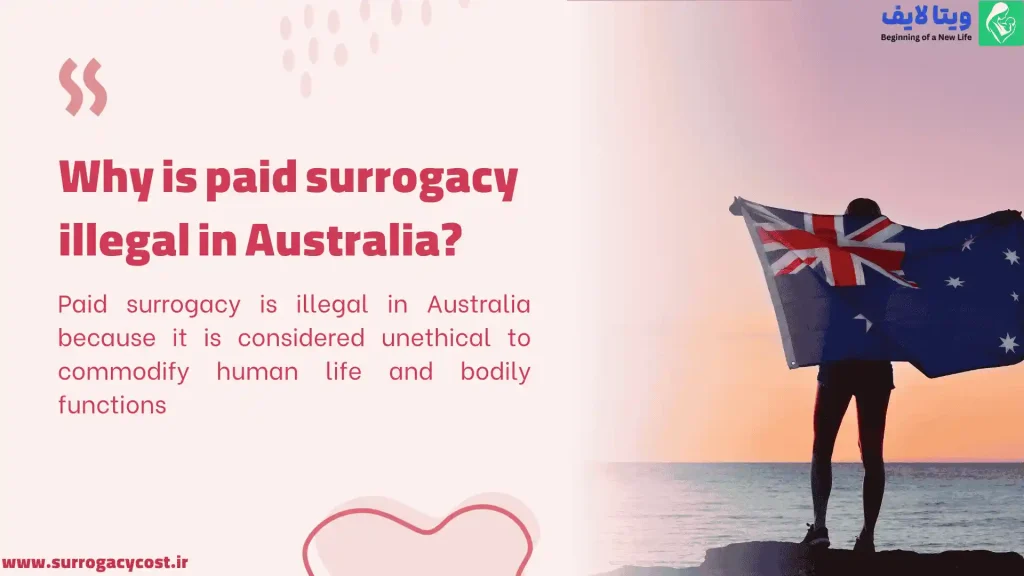
Surrogacy Law in Australia

Surrogacy in Australia is only allowed if it is altruistic, meaning surrogates cannot be paid beyond medical and related expenses. Commercial surrogacy is illegal and can lead to prison time, with penalties varying by state. Some states, like Western Australia, restrict surrogacy to heterosexual couples, while others, such as South Australia, allow same-sex couples and single individuals to participate. Intended parents are now legally recognized from birth in most states, eliminating the need for adoption. Since IVF costs for surrogacy are not covered by Medicare, many seek options abroad despite legal risks.

Why is paid surrogacy illegal in Australia
Why is paid surrogacy illegal in Australia?

Surrogacy Law in Iran: Is Surrogacy Legal in Iran?

Surrogacy is legal and common in Iran. The country follows Islamic law, which allows and organizes surrogacy in a clear way. Both paid (commercial) and unpaid (altruistic) surrogacy are allowed. This makes surrogacy in Iran a popular choice for couples, especially from the Middle East, who need fertility treatments.

Iran has clear surrogacy laws and experienced doctors, making the process smooth and safe. It is also one of the most affordable places for surrogacy, costing much less than in many Western countries.

Is Surrogacy Legal in Iran
is surrogacy legal in iran?

Religious and Legal Foundations of Surrogacy in Iran

Surrogacy is accepted in Iran because of its religious and legal rules. Most people in Iran (90–95%) follow Shia Islam, and religion strongly influences laws and society. In the past, both Shia and Sunni scholars were against surrogacy and other fertility treatments because of their traditional views on Islamic law.

This changed in 1999 when Ayatollah Ali Khamenei, Iran’s Supreme Leader, approved surrogacy in a religious ruling (fatwa). His decision allowed Muslim families to use surrogacy and other modern fertility treatments.

One reason for this acceptance is a key belief in Shia Islam called ijtihad, which allows religious scholars to rethink and update Islamic rules to fit modern times. Thanks to this, Shia scholars and families now see surrogacy as a good and acceptable way to have children while staying true to their faith.

Legal and Social Aspects of Surrogacy in Iran

Surrogacy is not written as a national law in Iran, but it follows religious rulings and court decisions. Iranian courts accept surrogacy contracts and provide legal protection for both intended parents and surrogates.

Here are some key points:

  • Simple Legal Process: Surrogacy agreements are clear, and legal parenthood is easily given to the intended parents without major problems.
  • Religious Support: Many religious leaders approve of surrogacy, which has helped more families accept it.
  • Advanced Medical Care: Iran has modern fertility clinics, skilled doctors, and high-quality facilities, making it a popular choice for international patients.

Why Iran is a Top Destination for International Surrogacy

Iran is a popular choice for surrogacy because it is legal, affordable, and well-accepted. Many couples from nearby countries come to Iran for surrogacy because the process is smooth, and both religious and legal systems support it.

Surrogacy in Iran shows how traditional beliefs, legal rules, and modern medical technology can work together. It proves that a country can respect its religious values while also helping families through advanced fertility treatments.

Is surrogacy in the UK legal
is surrogacy legal in UK?

Surrogacy Law in the United Kingdom

In the United Kingdom, altruistic surrogacy is legal, but commercial surrogacy is prohibited under the Surrogacy Arrangements Act 1985. Advertisements for surrogacy are also illegal, except when conducted by non-profit organizations as permitted under the Human Fertilisation and Embryology Act 2008. While intended parents can reimburse reasonable expenses, surrogacy agreements are not legally enforceable, meaning the surrogate mother retains full legal rights over the child unless a parental order or adoption is finalized.

A parental order is essential for transferring legal parenthood to the intended parents. Applications must be submitted within six months of the child’s birth, and at least one applicant must have used their gametes for conception and be domiciled in the UK. The child must reside with the applicants, and the surrogate’s informed and voluntary consent is mandatory unless the surrogate lacks the capacity to consent. Courts can authorize payments exceeding reasonable expenses if it serves the child’s best interests.

The child’s welfare is the primary consideration in all surrogacy cases, often leading to flexible interpretations of legal requirements. Landmark rulings, such as the Baby Cotton Case (1985) and Re X (2014), highlight that the best interests of the child take precedence over procedural technicalities.

In conclusion, while UK surrogacy laws prioritize child welfare and allow altruistic arrangements, the non-enforceable nature of agreements and detailed legal processes require careful planning and professional guidance.

Is surrogacy allowed in India now
is surrogacy legal in india?

Surrogacy Law in India

Under the Surrogacy (Regulation) Act, 2021, surrogacy in India is strictly regulated and only permitted for certain groups under specific conditions. The law limits surrogacy to Indian married couples who have been married for at least five years and face medical infertility issues. Additionally, the couple must meet the age criteria, with the woman aged 23–50 years and the man aged 26–55 years, and they must not have a biological or adopted child.

Single women may opt for surrogacy, but only if they are widowed or divorced and aged 35–45 years. However, single men are not eligible to pursue surrogacy under this law. Commercial surrogacy is entirely prohibited, and only altruistic surrogacy is allowed, meaning the surrogate cannot receive any compensation other than reimbursement for medical expenses.

Since November 4, 2015, foreign nationals have been banned from commissioning surrogacy in India. Prior to this, India was a popular destination for fertility tourism, offering significantly lower costs compared to Western countries. Commercial surrogacy arrangements in India were once regulated under the Indian Council of Medical Research guidelines, 2005, which allowed foreign couples to access surrogacy services.

However, changes in the law, including the landmark Balaz v. Union of India case, underscored citizenship complications, as the gestational carrier’s nationality determined the child’s citizenship. These regulatory shifts have significantly altered the surrogacy landscape in India, restricting access to protect the rights and welfare of surrogates while addressing ethical concerns surrounding commercial arrangements.

Surrogacy Law in Colombia

In Colombia, there are no clear rules about surrogacy at the moment, and a legal loophole exists. The current laws follow those of natural childbirth, meaning the child is registered with the names of the gestational carrier and her partner or spouse, if applicable. For the commissioning parents to be recognized as the legal parents, they must go through a paternity lawsuit before a judge, which may include genetic tests.

In July 2016, the Democratic Center, a right-wing political party, introduced a bill for the second time to define surrogacy and ban all forms of it.

1
Surrogacy is legally permitted in the USA (some states), Ukraine, Georgia, Iran, Canada, Greece, Colombia, and Mexico (some states)
2
Single parents can pursue surrogacy in the USA (certain states like California), Canada (altruistic), Georgia (until 2024 law changes), Colombia, and Mexico (some states like Tabasco).
3
Commercial surrogacy is currently legal in the United States (certain states like California and Nevada), Ukraine (for heterosexual married couples), Georgia (until 2024 law changes), Russia (with strict regulations), and Iran (for married heterosexual couples).
4
Surrogacy is illegal in Bangladesh. According to the UK Government's Knowledge Base, surrogacy is explicitly prohibited in the country.
5
Surrogacy in Peru occupies a legal gray area: it is neither explicitly prohibited nor fully regulated. While not illegal, the absence of clear legal guidelines makes it a risky option for intended parents.
6
Surrogacy is illegal in Azerbaijan. The country's laws do not recognize or regulate surrogacy arrangements. Specifically, the Criminal Code of Azerbaijan prohibits surrogacy for foreigners under Section 144-1.
7
Yes, surrogacy is legal in Ghana and is governed by a clear legal framework. The Human Reproductive Technologies Act (Act 1027), enacted in 2020, provides a structured process for surrogacy arrangements, ensuring the legal recognition of parental rights for intended parents.
8
Surrogacy is illegal in Hungary. Both altruistic and commercial surrogacy arrangements are prohibited and are considered to fall under the legal category of human trafficking
9
Surrogacy in Romania exists in a legal gray area: it is neither explicitly legal nor illegal. Romanian law does not provide specific regulations or frameworks for surrogacy arrangements.

Conclusion:

Understanding surrogacy laws around the world can be confusing because the rules are very different in each country. This guide has looked at the legal situations in many countries, sorting them into three categories: places where surrogacy is legal, places with restrictions, and places where it’s not allowed at all.

As we saw, in the United States, laws vary from state to state, so it’s important to get legal advice for your specific situation. Canada focuses on altruistic surrogacy, with strict rules about what expenses can be covered. Countries like Ukraine, Georgia, and Russia are more flexible, though they each have their own unique rules and challenges, like political stability. In Mexico, the laws are changing, with a move towards more inclusive surrogacy options. Meanwhile, countries like Thailand, India, and the UK have many rules about who can use surrogacy and what types of arrangements are allowed. Greece offers a clearer path, especially for people from the EU, while Australia has strict rules and limited access to surrogacy. Iran is different because its surrogacy laws are based on religious beliefs. Finally, Colombia falls into a legal grey area, where paternity cases are needed for intended parents to be recognized as the child’s legal parents.

Each country’s approach to surrogacy legality is unique, and it’s important to understand the specific laws and regulations before moving forward.

contact icon Get in touch with us for advice Contact us
dots
Related articles Read more
Comments

Leave a Reply

Your email address will not be published. Required fields are marked *