Surrogacy in Other Countries

Surrogacy in Other Countries
Author mehdisabet
Reading time 7 min
Published at 25 September 2025

A surrogacy program advertised for $25,000 may look like a bargain next to one costing $100,000. But what does each price actually cover? One may include donor eggs or several embryo transfers; the other may charge for these separately.

There is another question to settle before comparing prices: are you eligible for treatment in that country? Some destinations accept international intended parents under specific conditions. Others have tightened their rules, and a few options once promoted by agencies are no longer open to everyone.

Surrogacy Costs and Legal Status by Country in 2026

The figures below offer a starting point, not a final budget. Providers do not always include the same services, so two advertised prices may cover very different treatment plans.

Country Estimated Cost (USD) Legal Framework Access for Foreigners Main Consideration
Iran $18,000–$30,000 Surrogacy is practiced, but no single comprehensive statute governs every aspect Case-specific Parentage and contract enforceability need individual legal review
United States $100,000–$200,000+ Rules vary by state Depends on state law and eligibility Agency, surrogate, insurance, medical, and legal costs can add up
Georgia $40,000–$80,000 Permitted under specified conditions Generally available to qualifying applicants under reported current rules Access is restricted to qualifying heterosexual couples
Mexico $50,000–$75,000 Varies by state and legal interpretation Depends on jurisdiction and circumstances Legal protections are not uniform
Colombia $40,000–$80,000 Legal framework remains uncertain Requires case-specific review Parentage and legislative developments need close attention
Greece $70,000–$100,000* Court-authorized surrogacy is subject to statutory requirements, including residence rules Generally unavailable to intended parents who do not meet the Greek residence requirement A short visit or temporary stay should not be assumed to qualify
Kyrgyzstan $34,000–$51,000 National rules regulate surrogacy Eligibility must be confirmed Verify applicant qualifications and parentage procedures
Canada $70,000–$90,000 Altruistic surrogacy is permitted Depends on individual circumstances Paying a surrogate is prohibited, though eligible expenses may be reimbursed
Ukraine $40,000–$65,000* Permitted under existing rules, subject to eligibility; proposed legislation could restrict access Uncertain for foreign applicants Bill No. 15507 remains under parliamentary consideration
Kazakhstan Not applicable to new foreign applicants Commissioning arrangements are restricted to married Kazakh citizens under amendments effective July 26, 2026 Foreign intended parents are excluded under the new eligibility rules Older international cost guides are no longer reliable for eligibility

If you’d like to know more about where surrogacy is legal (green), banned (red), or unregulated (grey), check out our full guide on Surrogacy Law by Country.

Surrogacy in Iran

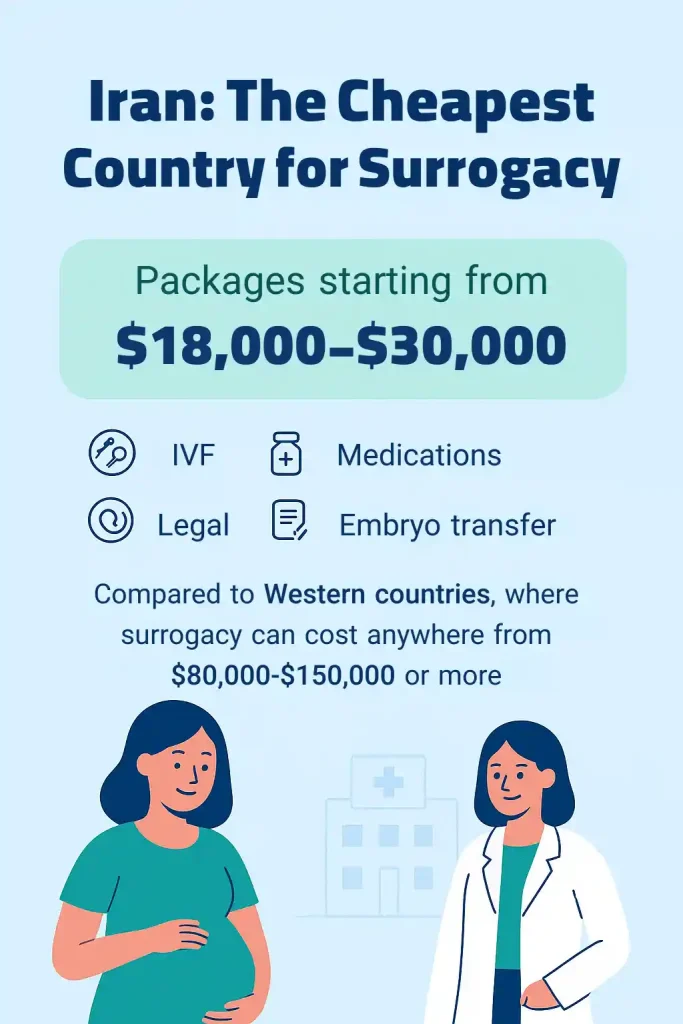
Cost is one reason some intended parents consider surrogacy in Iran. Some providers advertise programs starting at around $18,000, although the final amount depends on the services included. Egg donation, medication, additional embryo transfers, and further procedures may increase the bill.

Ask for an itemized quotation before comparing clinics. Check how many IVF cycles and embryo transfers are included, which services cost extra, and what happens if treatment needs to be repeated.

Surrogacy is practised in Iran, but the legal position cannot be reduced to a single rule covering every possible arrangement. The parties involved, their circumstances, and the documents required can all affect the process. A signed agreement should not be treated as a guarantee that every question about legal parentage will be resolved.

International intended parents have another issue to consider: documentation after birth. Before treatment begins, find out which records will be issued and how parentage will be established. The authorities in the parents’ home country should also confirm the requirements for citizenship and travel documents.

Iran may be less expensive than the United States, but a lower starting price does not tell the whole story. Compare the full treatment plan, legal arrangements, and expected additional expenses before making a decision.

Cheapest Country for Surrogacy

Surrogacy in the United States

The United States is an established destination for surrogacy, but there is no single nationwide legal framework that applies identically in every state. State laws determine important issues, including whether an arrangement is permitted, how agreements are handled, and how legal parentage is established.

Choosing a state is therefore one of the first decisions intended parents need to make. An arrangement that works for one family may not be available to another, depending on their circumstances and the applicable law.

Cost is another major consideration. A quoted price may include IVF and agency services but exclude some expenses associated with the surrogate, insurance, pregnancy care, legal representation, or additional treatment.

Request a detailed budget before signing an agreement. It should distinguish included services from expenses that may arise later. If a quote is substantially lower than competing offers, check what has been left out.

For more information about the legal framework and available options, read our guide to Surrogacy in the US.

If you want to learn more about the Islamic perspective on surrogacy, check out our detailed guide on Surrogacy in Islam.

Surrogacy in Georgia

Georgia has attracted international intended parents partly because its surrogacy programs have generally been less expensive than those in the United States. However, treatment is not available to every family.

Eligibility depends on the applicable rules and the intended parents’ circumstances. Before paying a clinic or agency, obtain advice from an independent Georgian lawyer who can confirm whether your proposed arrangement meets current requirements.

The process does not end with delivery. Intended parents should understand how parentage will be established, which birth documents will be issued, and what their home country requires before the child can travel.

Georgia may be a suitable option for some families, but the presence of fertility clinics does not establish eligibility. Check current restrictions and any proposed legal changes before making financial commitments.

Surrogacy in Mexico

Surrogacy in Mexico  various international comparisons has something to do with the lower costs of the programs there compared to the US. However, the law in regards to surrogacy may vary in states and under different circumstances surrounding the future parents.

A simple generalization that surrogacy is possible in Mexico is not sufficient. It is important to understand the jurisdiction where you operate and the legal status of the surrogate Mother, the intended parents, and the baby born.

Before putting down a deposit on surrogacy services, ask for independent Mexican attorney’s opinion on the agreement you are to sign. The information should include parentage issues, documents you will be getting and legal actions necessary before the leave from the country.

And finally, there is one more practical issue: will the documents from Mexico be accepted in your home country? The birth certificate might not be enough in order to deal with citizenship and travel document needs of the newborn.

Surrogacy in Colombia

Colombia has attracted attention from intended parents seeking fertility services abroad, partly because of its comparatively competitive prices. Yet the legal position of surrogacy remains an important source of uncertainty.

Surrogacy arrangements have taken place in the country, but that does not mean every agreement offers the same legal protections. Contractual obligations, financial arrangements, parentage, and potential legislative developments all deserve careful review.

Foreign intended parents should consult a Colombian lawyer with relevant experience before choosing a clinic or signing an agreement. Ask for an assessment of your specific circumstances rather than relying on a general statement that surrogacy is available.

Price comparisons are useful, but they cannot establish whether a particular arrangement is legally suitable. The expected costs should be considered alongside the legal process and the documents required after birth.

Our guide to Surrogacy and Egg Donation in Colombia provides further background.

Surrogacy in Greece
Surrogacy in Greece

Surrogacy in Greece

Greece previously attracted some international intended parents because its legal framework allowed surrogacy with court authorization. A change introduced in 2025 significantly affected access for people living outside the country.

Article 46 of Law 5197/2025 introduced residence requirements concerning the intended mother applying for court authorization and the surrogate. Intended parents who do not meet the applicable Greek residence requirements should not assume they can pursue a new arrangement there.

A temporary stay or a visit for medical treatment should not automatically be treated as sufficient. Anyone who believes they qualify needs a Greek lawyer to examine their actual residence status before making payments.

Older articles and agency pages may still describe Greece as an accessible destination for international intended parents. Check when the information was published and whether it reflects the current legislation.

The estimated cost range in the comparison table is provided for reference. It is not confirmation that a program is open to a particular family.

Kyrgyzstan surrogacy law foreigners 2025
Surrogacy in Kyrgyzstan

Surrogacy in Kyrgyzstan

Kyrgyzstan is sometimes presented as a lower-cost surrogacy destination. National rules govern aspects of the process, but an advertised price does not establish that a foreign applicant qualifies.

Before proceeding, confirm the current eligibility requirements with a local lawyer who handles surrogacy cases. Ask which agreements are needed, how the surrogate’s consent is documented, and how the intended parents’ legal status will be established after birth.

International families should also consider the documents required to register the birth and take the child home. Those requirements may involve both local procedures and the citizenship and immigration rules of the parents’ country.

Request a written explanation of the legal and administrative process, including who is responsible for each stage and what happens if an approval or document is delayed.

Surrogacy in Canada

Altruistic surrogacy is allowed in Canada. According to the federal law, Assisted Human Reproduction Act, a payment to a surrogate for carrying the pregnancy is illegal. However, there are certain out-of-pocket expenses that can be reimbursed if they meet all criteria.

That makes a difference to how a Canadian arrangement will work. The intended parents should know what expenses will be covered, what receipts they should save, and how the reimbursement should be documented. Just because of the flat rate, it does not mean it will fit the law.

Overall, it may be still costly. The medical treatments, lawyer fees, reimbursement criteria, and travel will all influence the budget. Additionally, it may take some time to find a surrogate.

Intended parents from abroad should study the procedure of the parentage and the child’s citizenship/travel documentation under Canadian province before the treatment starts. The altruistic model in Canada may work well for some people, but not for others.

Surrogacy in Ukraine

There is a history of surrogacy service delivery in Ukraine under defined legal terms. However, for foreign intended parents, a pending legislative amendment has thrown up questions about the future.

Bill No. 15507 has been registered since August 2026. The Bill seeks to restrict access to ART services, including surrogacy services, for foreigners and stateless people. There will be an exception in terms of citizenship of Ukraine and a condition of permanent residence for eligible Ukrainian citizens. There will be criminal liability in respect of certain violations.

The bill is still under parliamentary deliberation and not yet enacted into law. Thus, saying that Ukraine has banned foreign surrogacy would not be accurate. However, there are changes worth considering such that intended parents do not base their decisions on past information alone. There is a bill status page on the Ukrainian Parliament website.

Anyone looking for help should first consult a Ukrainian attorney before paying money. Inquire about whether the invoice has been processed, whether any transitional provisions may apply to your case, and how the issue of parentage and passporting of the child will be managed.

There are also logistical considerations. The security situation, travel disruptions, access to clinics, and time taken in filling out paperwork can all be factors in influencing a family’s plans. These issues should form part of the decision-making process, not just the small print.

Countries Where Previous Surrogacy Options Have Changed

Some countries still appear in older surrogacy guides even though their eligibility rules have changed. Kazakhstan is one clear example.

Kazakhstan

Kazakhstan is no longer an option for foreign intended parents under the amended eligibility rules. Law No. 350-VIII amended Article 54 of the Code on Marriage and Family, with the relevant changes taking effect on July 26, 2026.

Under the amended provision, only married citizens of Kazakhstan may commission a surrogacy arrangement. Foreign intended parents should not rely on older agency pages or cost guides that describe the country as an open international destination. The current wording can be checked in Article 54 of Kazakhstan’s Code on Marriage and Family.

India

There are significant legal limitations on surrogacy in India, especially with regard to commercial surrogacy and eligibility criteria. A foreign couple looking for a commercial surrogacy arrangement cannot presume they will be able to have one in India. When determining their eligibility, it is better to consult current legislation.

Italy

Italian law has introduced restrictions affecting surrogacy arrangements involving Italian citizens outside the country. Anyone with a relevant connection to Italy should obtain current legal advice before considering an overseas arrangement.

Georgia and Ukraine

Georgia has eligibility criteria; proposed laws in Ukraine may limit foreign access. This is an entirely separate issue from the eligibility criteria in Georgia and the proposed Ukrainian legislation still pending approval. Make sure you understand the criteria for your family’s situation before making any commitments to treatment.

Countries Where Access Requires Extra Caution

Some countries are mentioned in discussions of international surrogacy, but that does not establish that foreign intended parents can access a lawful, established program.

Country What Intended Parents Should Check
United Arab Emirates Changes to assisted-reproduction legislation do not automatically authorize surrogacy. Confirm whether the specific arrangement is permitted.
Ghana National legislation includes provisions concerning surrogacy and court orders, but foreign eligibility and parentage procedures need individual legal review.
Nigeria Obtain current, jurisdiction-specific advice. Do not assume that surrogacy is uniformly regulated or available throughout the country.

Assisted reproduction and surrogacy are not interchangeable legal categories. A country may permit certain fertility treatments without allowing the arrangement you intend to pursue.

How to Choose a Country for Surrogacy

Eligibility before cost is key. Seek the opinion of an independent lawyer in the destination country to determine your eligibility and understand how parentage of the child will be proven.

Consider the total cost, too. While the quote might include the cost of one round of IVF, other costs such as egg donation, legal fees, costs of pregnancy, lodging and travel may increase the total price.

Last but certainly not least, learn how you plan to bring the child back home. Your birth certificate from the destination country might not be adequate for getting a passport, citizenship or establishing parentage abroad. The UK government’s guidance on surrogacy overseas states why it is important to seek legal counsel in both jurisdictions.

Before making a commitment, get clear answers to these questions:

  • Are we eligible under the rules currently in force?
  • Who will be recognized as the child’s legal parents, and when?
  • Which documents will be issued after birth?
  • What does the quoted price include, and what could cost extra?
  • What happens if treatment, birth registration, or travel takes longer than expected?

Written answers are worth more than a general assurance that a program is “available to foreigners.”

Final Thoughts

There is not one best destination for every surrogate pregnancy experience. The United States has laws depending on the state of choice, yet the costs might be relatively high. Georgia and Kyrgyzstan may be worth considering for suitable candidates. In Canada, an altruistic approach prevails, whereas Iran might provide a relatively inexpensive treatment process requiring legal arrangement.

Some destinations require additional caution. In Greece, one needs to reside there, thus restricting the majority of international clients. Kazakhstan changed its laws making foreign commissioning parents ineligible, while Ukraine has some uncertainties regarding future suitability due to proposed legislation.

Everything is quite simple in terms of the practical order of priority: make sure that you are eligible for using the program, find out about the establishment of parentage and then compare costs. Any low costs are meaningless if the treatment process is not available to you.

contact icon Get in touch with us for advice Contact us
Comments

Leave a Reply

Your email address will not be published. Required fields are marked *