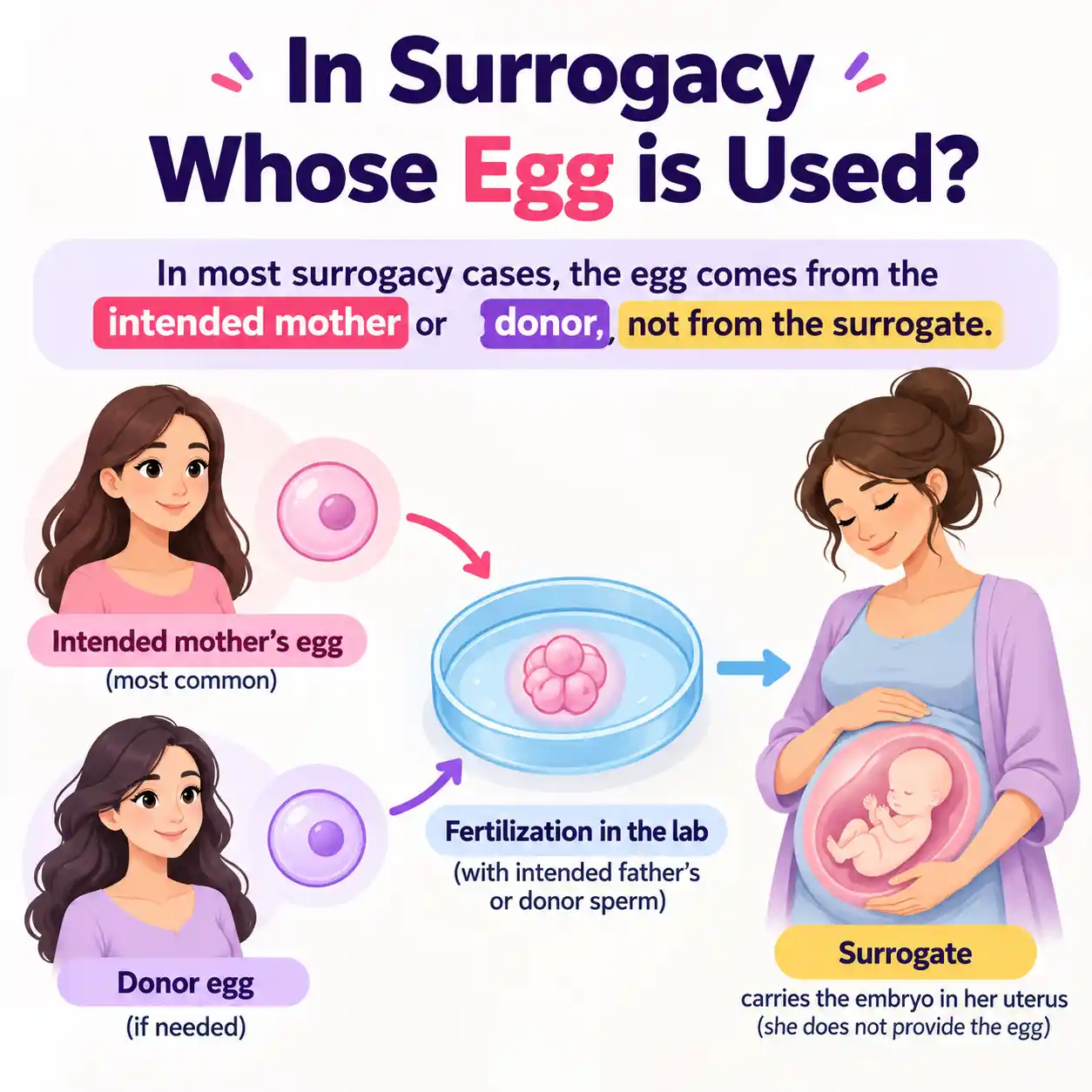
Behind every surrogacy story is a family waiting for a miracle. But one of the first questions people often ask is whose egg is used in surrogacy — the surrogate’s, the intended mother’s, or a donor’s? The answer shapes everything that follows, from genetics to emotional connection. In today’s world, most surrogacies use the intended mother’s or a donor’s egg, while the surrogate simply carries the baby with no genetic link. It’s a process where science meets love — turning hope into life, and biology into belonging.
What Is Surrogacy and How Does It Work?
Surrogacy is a reproductive process in which another woman carries and delivers a baby for someone else — often referred to as the intended parents. In most modern cases, this is known as gestational surrogacy, where the pregnancy is created through in vitro fertilization (IVF). During IVF, an embryo is formed in a laboratory using the egg and sperm from the intended parents or from donors. The embryo is then transferred to the surrogate’s uterus. Because the surrogate mother doesn’t provide her own egg, she has no genetic connection to the baby, which helps keep legal and emotional boundaries clear.
In traditional surrogacy, however, the surrogate’s own egg is used, meaning she is genetically related to the child. This approach is much less common today and is restricted or illegal in many countries due to complex legal and emotional implications.
Overall, surrogacy provides a pathway to parenthood for couples and individuals who cannot conceive or carry a pregnancy on their own — including those with medical conditions, previous hysterectomies, or same-sex male couples. Understanding whose egg is used in surrogacy helps clarify whether the child will share a genetic link with the intended mother or with a donor, a factor that influences both medical planning and emotional expectations.
Surrogacy makes it possible for individuals or couples who cannot carry a pregnancy themselves to have a biological child. The question of whose egg is used in surrogacy depends on the type of arrangement — most commonly, either the intended mother’s egg or a donor egg is used. In some rare cases, the surrogate’s own egg is involved, which creates a traditional surrogacy. Below, we explain each option and its implications.
Intended Mother’s Egg
When possible, using the intended mother’s own eggs is the preferred approach. Through IVF, her eggs are retrieved, fertilized with her partner’s sperm (or donor sperm), and the resulting embryo is transferred to the gestational carrier’s uterus. This allows the child to share a genetic connection with the intended mother, even though she does not carry the pregnancy herself. This option is ideal for women who produce healthy eggs but are unable to carry a pregnancy due to uterine issues, health risks, or past pregnancy complications. It offers the opportunity to maintain a biological link while ensuring a safe pregnancy through a surrogate.
Donor Egg
In cases where the intended mother’s eggs are not viable — due to age, fertility problems, or genetic concerns — an egg donor is used. Donor eggs are typically provided by young, healthy women who undergo medical and genetic screening before donation. The eggs are fertilized through IVF using the intended father’s sperm (or a sperm donor’s), and the embryo is transferred to the gestational surrogate. When a donor egg is used, the child will be genetically related to the egg donor and the intended father (if his sperm is used). This option is also commonly chosen by same-sex male couples or single men who wish to become parents through surrogacy.
Surrogate’s Own Egg (Traditional Surrogacy)
In traditional surrogacy, the surrogate uses her own egg, making her the biological mother of the child. The pregnancy is achieved through artificial insemination using the intended father’s sperm or donor sperm, without the use of IVF. Because the surrogate is genetically related to the baby, this method involves greater emotional and legal complexity. Traditional surrogacy is far less common today and is even prohibited in many regions due to the potential for parental rights disputes. Most modern surrogacy arrangements use the gestational method instead, which ensures that the surrogate has no genetic link to the child.
whose egg is used in surrogacy?
Method
Egg Source
Fertilization
Genetic Connection
Common Use Cases
Gestational Surrogacy
Intended Mother
IVF
✅ With intended mother and father
Women with healthy eggs who cannot carry pregnancy
Donor Egg Surrogacy
Egg Donor
IVF
✅ With egg donor and father
• Women with egg issues • Single men • Male gay couples
Traditional Surrogacy
Surrogate's Own Egg
Artificial Insemination
✅ With surrogate and father
Rare today due to legal/emotional complexity
Whose Sperm Is Used in Surrogacy?
In most surrogacy arrangements, the sperm comes from one of the intended parents — usually the intended father or, in same-sex male couples, one of the partners. The chosen sperm is combined with the intended mother’s or donor’s egg to create an embryo that’s transferred to the surrogate’s uterus. This ensures a genetic connection between at least one parent and the child.
If the intended father has fertility issues or a genetic condition, donor sperm may be used instead. For same-sex male couples, both partners can participate through split insemination, where eggs are divided and fertilized with each partner’s sperm separately. This allows both to have a biological link to their children.
No matter whose sperm is used, surrogacy offers a pathway to parenthood that preserves a genetic bond and fulfills the shared dream of building a family.
Egg Retrieval and Fertilization Process
Once the intended parents or donors are chosen, the next crucial step in surrogacy is the egg retrieval and fertilization process. Before retrieval, the egg provider — whether the intended mother or an egg donor — takes prescribed hormonal medications to stimulate the ovaries and produce multiple mature eggs. These eggs are then carefully monitored through ultrasound and hormone testing to determine the ideal time for collection. When the follicles reach optimal size, a minor outpatient procedure is performed under light anesthesia to gently retrieve the eggs from the ovaries using a fine needle guided by ultrasound.
After collection, the eggs are immediately transferred to the fertility laboratory, where fertilization takes place. The chosen sperm — from the intended father or a donor — is combined with the retrieved eggs in a controlled environment. In some cases, a specialized method called intracytoplasmic sperm injection (ICSI) is used to enhance fertilization success. The resulting embryos are then cultured for several days as specialists monitor their development and select the healthiest one for transfer to the surrogate’s uterus.
Each stage of this process is closely supervised by fertility experts to ensure the highest chance of a successful pregnancy and a healthy baby, marking one of the most delicate yet hopeful moments in every surrogacy journey.
How Does the Quality of Eggs Affect IVF Success Rate?
The quality of eggs is one of the most decisive factors influencing the success rate of IVF and, consequently, surrogacy. High-quality eggs are more likely to mature properly, fertilize successfully, and develop into healthy embryos with normal chromosomes. In contrast, poor-quality eggs may lead to failed fertilization or embryos that cannot implant or grow normally, which lowers overall success rates.
Egg quality naturally declines with age, especially after 35, as the number of genetically healthy eggs decreases. However, lifestyle and health factors also play a major role. Balanced nutrition, maintaining a healthy weight, avoiding smoking or alcohol, and managing stress all contribute to better ovarian function. Fertility specialists often assess ovarian reserve and egg health using blood tests such as AMH levels and ultrasound follicle counts before starting treatment.
Ultimately, the stronger the egg, the greater the chance of forming a viable embryo and achieving a healthy pregnancy through surrogacy. While advanced lab techniques and sperm quality matter, the egg provides the essential foundation for life. Focusing on improving or selecting eggs of the highest quality remains one of the most effective ways to enhance IVF success.
FAQs About Egg Use in Surrogacy
1
Usually, the intended mother’s or a donor’s egg is used — not the surrogate’s.
2
The surrogate's ovaries are not used. The egg comes from either the intended mother or an egg donor.
3
Yes, it can. If the intended mother has healthy eggs, they are often used. If not, an egg donor's eggs are used.
4
Eggs are collected through a short, ultrasound-guided procedure after hormone stimulation.
5
No, in the most common form of surrogacy, called gestational surrogacy, surrogates do not use their own eggs. The surrogate carries an embryo created from the intended parents' or a donor's egg and sperm. However, in a less common and older form called traditional surrogacy, the surrogate's own egg is used.
6
No. In gestational surrogacy, the surrogate does not use her own eggs. Only in traditional surrogacy does she provide the egg.
7
It can be the intended mother’s or an egg donor’s, depending on fertility and medical factors.
8
Yes. Even with a donor egg, the intended parents are the legal and emotional parents once the embryo is created for them.
9
Yes, when the intended mother’s egg and intended father’s sperm are used, the baby carries both parents’ DNA.
10
Not genetically, but shared environment during pregnancy and parenting can influence physical and emotional traits.
11
Yes, through preimplantation genetic testing (PGT), clinics can identify and select embryo gender.
12
Compensation varies by country but usually ranges from $5,000 to $10,000 per donation cycle.
13
Eggs are retrieved in batches, not individually, and compensation covers the whole cycle — not per egg.
14
Most clinics prefer donors under 33, but some accept women up to 35 if fertility tests are favorable.
15
Typically 34–35 years old; beyond that, egg quality declines significantly.
16
Legally and emotionally, the woman who intended and carried the pregnancy (or arranged the surrogacy) is the real mother.
17
Potential side effects include hormonal changes, mild pain after retrieval, and emotional stress.
18
The baby inherits genetics from the donor, not the recipient, though family rearing can shape resemblances.
19
Avoid alcohol, smoking, heavy exercise, and unprotected intercourse during stimulation and recovery.
20
You may feel mild bloating, cramping, or fatigue for a few days; the body usually recovers quickly with rest and hydration.
Conclusion
At its heart, surrogacy is a story about hope, love, and the desire to become a parent. Understanding whose egg is used in surrogacy isn’t just a medical question — it’s about the connection families dream of creating. Whether the journey begins with an intended mother’s egg or the help of a donor, each step brings intended parents closer to holding their baby for the first time. With the right care, trust, and guidance, surrogacy turns a deeply personal dream into a living, breathing miracle.