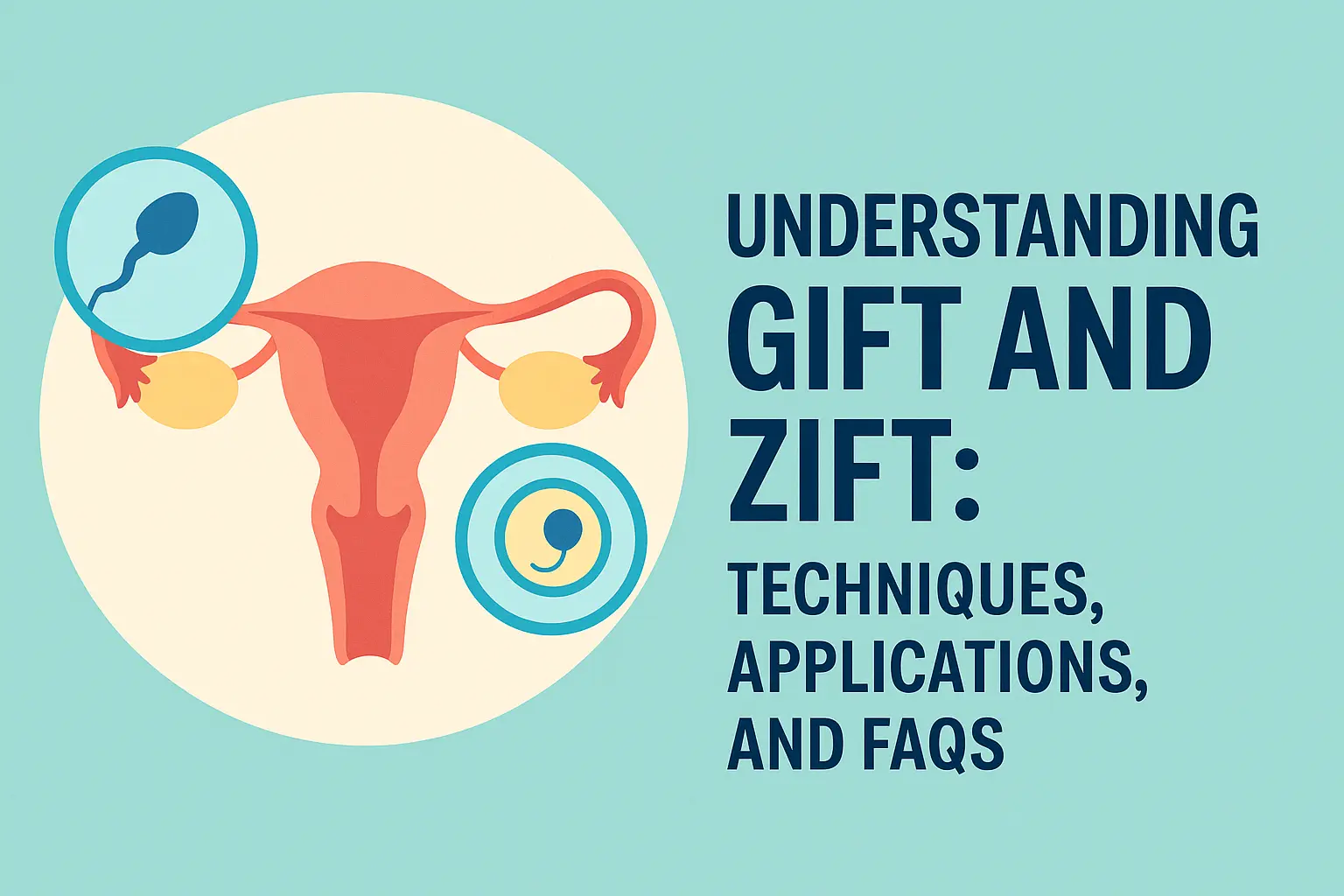
GIFT (Gamete Intrafallopian Transfer) and ZIFT (what is zift: Zygote Intrafallopian Transfer) are assisted reproductive technologies (ART) designed to help individuals or couples facing infertility achieve pregnancy. These techniques are modified versions of in vitro fertilization (IVF), involving the manipulation of gametes (sperm and eggs) or zygotes (fertilized eggs) and their transfer into the fallopian tubes to facilitate natural conception or early embryonic development. While both methods aim to enhance fertility, they differ in their processes, applications, and outcomes. This difference is often discussed under the comparison of gift vs zift.
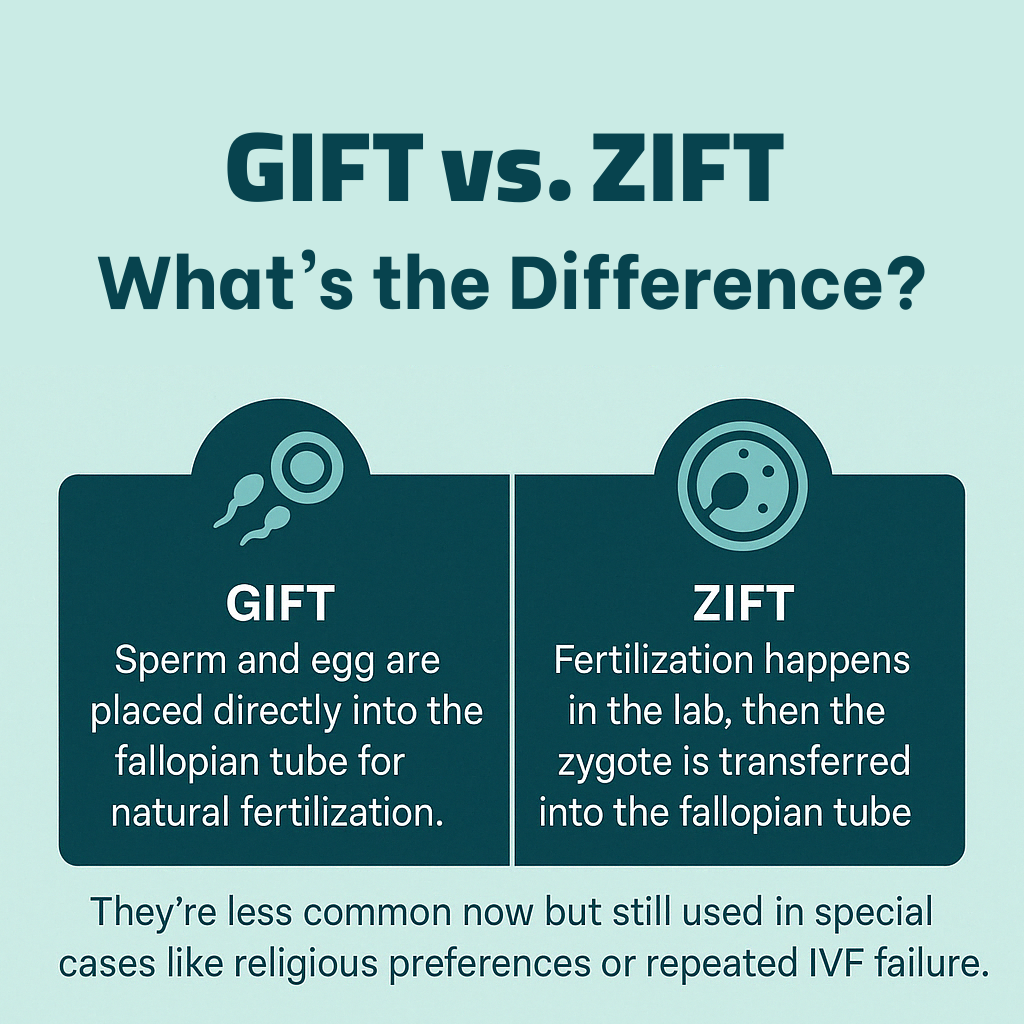
GIFT involves placing unfertilized eggs and sperm (gametes) directly into the fallopian tubes, allowing fertilization to occur naturally within the body (in vivo). ZIFT, on the other hand, involves fertilizing the egg in a laboratory (in vitro) and transferring the resulting zygote into the fallopian tubes within 24 hours for implantation. Historically, GIFT and ZIFT had higher success rates than IVF in women with normal fallopian tubes, but today, IVF’s improved success rates and lower surgical risks have made GIFT and ZIFT less common.
They remain relevant for specific cases, such as religious or medical preferences favoring fertilization within the body or after repeated IVF failures. This article provides an in-depth exploration of GIFT and ZIFT, addressing their procedures, differences, advantages, risks, and more. Below, we answer frequently asked questions to clarify common concerns and misconceptions.
what is the difference between zift and gift
The main difference between ZIFT and GIFT is based on where fertilization occurs. In GIFT, the eggs and sperm are placed directly into the fallopian tubes, so fertilization happens naturally inside the body. In contrast, ZIFT uses laboratory fertilization, where the egg is fertilized outside the body and the resulting zygote is then transferred to the fallopian tube. This GIFT and ZIFT difference highlights how GIFT is considered closer to natural conception, while ZIFT ensures confirmation of fertilization before the transfer.
Frequently Asked Questions (FAQs)
When does GIFT and ZIFT be applied?
GIFT and ZIFT are typically applied for couples with unexplained infertility, mild endometriosis, or ovulatory disorders, provided the fallopian tubes are healthy. GIFT may be preferred by those who wish for fertilization to occur naturally within the body, often due to religious or ethical beliefs. ZIFT is used when controlled fertilization in a laboratory is desired, offering higher certainty of fertilization before transfer. These methods may also be recommended after multiple failed IVF or ICSI cycles or when sperm quality is adequate but not severely compromised.
What is GIFT technique?
The GIFT technique involves retrieving eggs from the ovaries, mixing them with sperm, and immediately transferring the mixture into the fallopian tubes via laparoscopy. Fertilization occurs naturally inside the body, mimicking natural conception more closely than IVF. In fact, the gift full form in biology is Gamete Intrafallopian Transfer, a method designed to assist couples facing infertility.
difference between zift and gift
What is the difference between ZIFT and IVF?
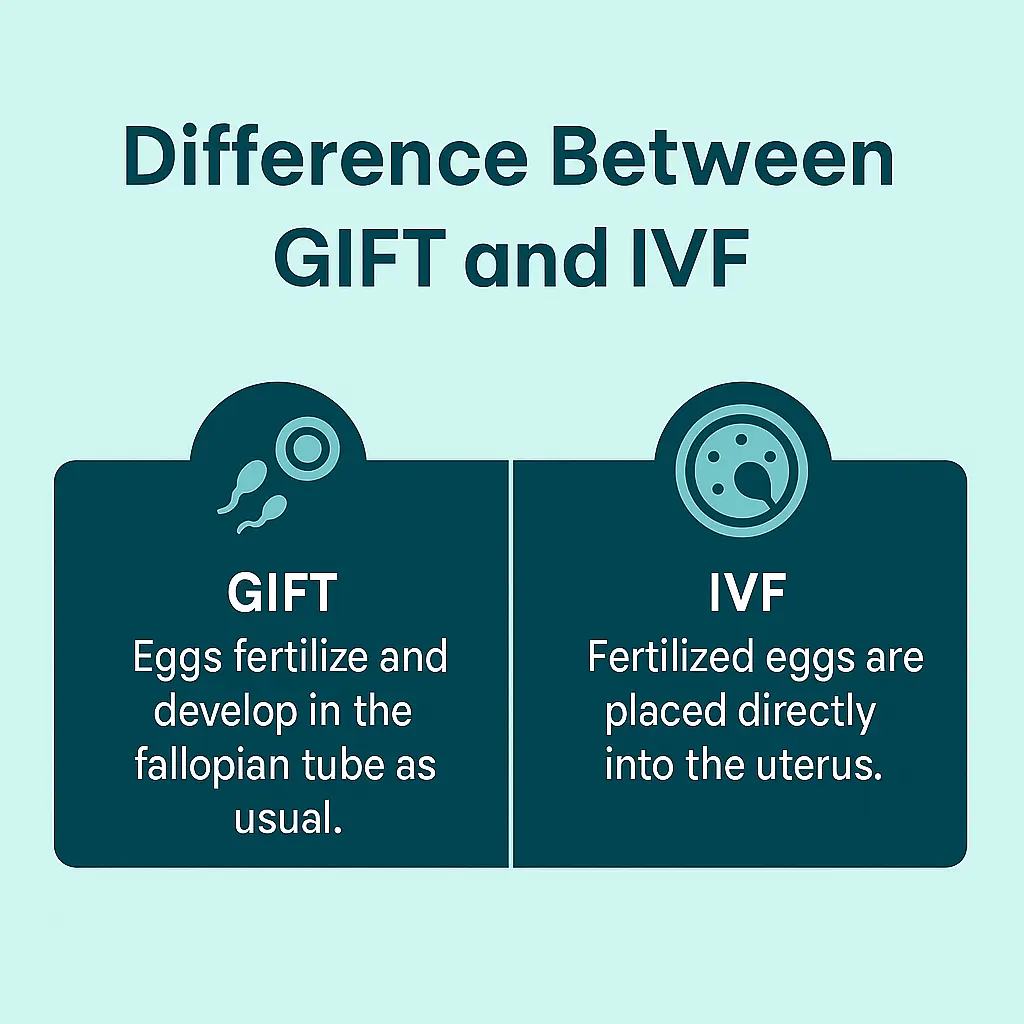
ZIFT involves fertilizing eggs in a laboratory and transferring the resulting zygote to the fallopian tubes within 24 hours, whereas IVF transfers embryos directly to the uterus after fertilization and early development in the lab. ZIFT requires healthy fallopian tubes, while IVF does not.
What is the meaning of ZIFT?
If you’re looking for a zift definition, it is Zygote Intrafallopian Transfer. This is an assisted reproductive procedure where a fertilized egg (known as a zygote) is placed directly into a woman’s fallopian tube to continue its development and achieve implantation.
difference between gift and ivf
What does ZIFT mean?
ZIFT stands for Zygote Intrafallopian Transfer, a procedure where a fertilized egg (zygote) is placed in the fallopian tube to continue development and implantation. In other words, when people search for zift meaning, they are referring to this assisted reproductive technology that helps overcome infertility by transferring a lab-fertilized egg into the fallopian tube.
How are ZIFT and GIFT different from intrauterine transfer?
GIFT and ZIFT involve transferring gametes or zygotes to the fallopian tubes, requiring healthy tubes and often laparoscopy under anesthesia. Intrauterine transfer, as in IVF, places embryos directly in the uterus, bypassing the fallopian tubes, making it suitable for patients with tubal damage.
What is ZIFT fertility treatment?
ZIFT fertility treatment is an assisted reproductive technology (ART) that helps couples facing infertility achieve pregnancy. In this procedure, eggs are retrieved from the ovaries and fertilized with sperm in a laboratory (in vitro). The resulting zygote is then transferred into the fallopian tube within 24 hours, allowing natural implantation and early development to occur inside the body. Unlike GIFT, where fertilization happens in vivo, ZIFT ensures that fertilization is confirmed before transfer, which can increase the chances of success in certain cases.
What are the risks of GIFT and ZIFT?
Risks include multiple pregnancies (~12% chance), ectopic pregnancy (~1% chance), ovarian hyperstimulation syndrome (OHSS), and surgical risks from laparoscopy, including complications from anesthesia (e.g., allergic reactions or breathing issues). There’s also a higher risk of miscarriage or stillbirth (~18%) and a chance of unsuccessful fertilization (especially with GIFT) or implantation. Due to these risks and IVF’s higher success rates, GIFT and ZIFT are rarely used today.
What are the risks of GIFT and ZIFT?
Risks include multiple pregnancies (~12% chance), ectopic pregnancy (~1% chance), ovarian hyperstimulation syndrome (OHSS), and surgical risks from laparoscopy, including complications from anesthesia (e.g., allergic reactions or breathing issues). There’s also a higher risk of miscarriage or stillbirth (~18%) and a chance of unsuccessful fertilization (especially with GIFT) or implantation. Due to these risks and IVF’s higher success rates, GIFT and ZIFT are rarely used today.
Is GIFT in vivo or in vitro?
GIFT is an in vivo procedure because fertilization occurs naturally inside the body (in the fallopian tubes) after gametes are transferred.
What are the side effects of GIFT?
Side effects may include bloating, cramping, or discomfort from ovarian stimulation, risks associated with laparoscopy (e.g., infection, bleeding, or anesthesia complications), and potential emotional stress from the procedure’s uncertainty.
What is the difference between a gamete and a zygote?
A gamete is a reproductive cell (sperm or egg) that carries half the genetic material needed for reproduction. A zygote is the fertilized egg formed when a sperm and egg unite, containing the full genetic material.
What is the procedure of GIFT involves?
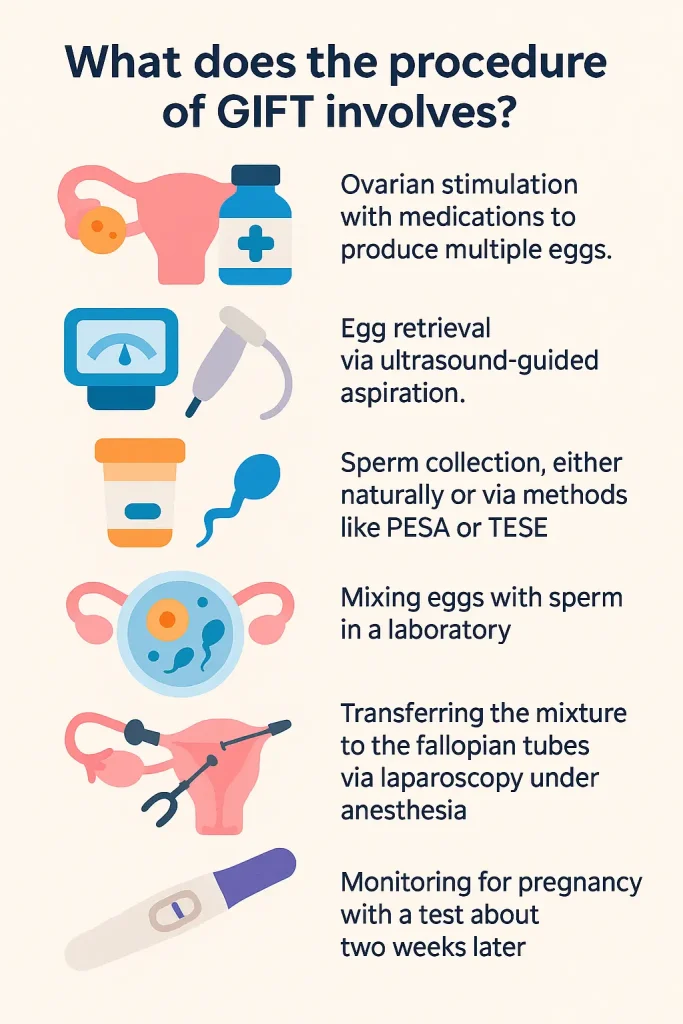
The GIFT procedure includes:
Ovarian stimulation with medications to produce multiple eggs.
Egg retrieval via ultrasound-guided aspiration.
Sperm collection, either naturally or via methods like PESA or TESE in cases of azoospermia (zero sperm count).
Mixing eggs with sperm in a laboratory.
Transferring the mixture to the fallopian tubes via laparoscopy under anesthesia.
Monitoring for pregnancy with a test about two weeks later.
What is the procedure of GIFT involves
When is ZIFT used?
ZIFT is used for couples with infertility issues where fertilization needs to be confirmed in the lab, but the fallopian tubes are healthy enough for zygote transfer and natural implantation. It may also be considered after repeated IVF or ICSI failures.
What are the advantages of gamete intrafallopian transfer?
Advantages of GIFT include:
Fertilization occurs naturally in the body, aligning with some ethical or religious preferences.
Potentially higher success rates in patients with healthy fallopian tubes compared to early IVF methods.
Less laboratory manipulation compared to IVF.
What is the treatment of gifts?
In the context of fertility, GIFT is a treatment for infertility, not a condition requiring treatment. It involves transferring gametes to the fallopian tubes to achieve pregnancy.
What is the 3 gift method?
The term “3 gift method” is not a standard term in fertility treatment. It may refer to the three key steps in GIFT: egg retrieval, gamete mixing, and fallopian tube transfer. Clarification is needed for non-medical contexts.
What are the 5 types of gifts?
In fertility, GIFT refers solely to Gamete Intrafallopian Transfer. Outside this context, “types of gifts” may refer to legal or cultural categories (e.g., inter vivos gifts, mortis causa gifts, charitable gifts, etc.), but this is unrelated to ART.
What is gift condition?
There is no medical term “gift condition” in ART. It may refer to the prerequisites for GIFT, such as healthy fallopian tubes, adequate sperm quality, and ovulatory function.
What is gift process?
The GIFT process involves ovarian stimulation, egg retrieval, mixing eggs and sperm, and transferring them to the fallopian tubes via laparoscopy for natural fertilization.
What is gift process?
The GIFT process involves ovarian stimulation, egg retrieval, mixing eggs and sperm, and transferring them to the fallopian tubes via laparoscopy for natural fertilization.
What is a gift example?
An example of GIFT is a couple with unexplained infertility undergoing ovarian stimulation, egg retrieval, and laparoscopic transfer of eggs and sperm to the fallopian tubes, resulting in a successful pregnancy.
What are the three 3 elements required for a valid gift?
In a legal context, a valid gift requires:
Intent to give the gift.
Delivery of the gift to the recipient.
Acceptance by the recipient. This is unrelated to GIFT in fertility treatment.
What are the 4 rules of gifts?
There are no standardized “4 rules of gifts” in ART. In legal terms, rules for gifts may include intent, delivery, acceptance, and lack of consideration (no payment expected). Clarification is needed for context.
What is mortis causa?
Mortis causa refers to a gift or transfer of property made in contemplation of death, effective only upon the donor’s passing. This is a legal term unrelated to GIFT or ZIFT.
What is the major gift process?
In ART, the GIFT process is as described: egg retrieval, gamete mixing, and fallopian tube transfer. In fundraising or legal contexts, “major gift process” refers to soliciting large donations, unrelated to fertility.
What is the principle of gift?
In fertility, the principle of GIFT is to facilitate natural fertilization in the fallopian tubes by placing gametes there. In legal terms, a gift is a voluntary transfer without compensation.
What is the gift cycle?
The GIFT cycle refers to the full process of one GIFT attempt, including ovarian stimulation, egg retrieval, gamete transfer, and pregnancy monitoring, typically lasting a few weeks.
What is the three gift technique?
This term is not standard. It may loosely refer to the three phases of GIFT: preparation (stimulation/retrieval), transfer, and post-transfer monitoring. Clarification is needed.
What is the gift theory?
There is no “gift theory” in ART. In sociology or anthropology, gift theory explores reciprocal giving in societies, unrelated to fertility treatments.
Which technique called gift is recommended?
GIFT is recommended for couples with healthy fallopian tubes, unexplained infertility, or religious preferences for in vivo fertilization. It’s less common today due to IVF’s higher success rates and lower risks.
Which method is used to have a child through gift?
The GIFT method involves ovarian stimulation, egg retrieval, mixing eggs with sperm, and transferring them to the fallopian tubes for natural fertilization and pregnancy.
Why is ZIFT better than GIFT?
ZIFT may be preferred because fertilization is confirmed in the lab before transfer, increasing certainty compared to GIFT, where fertilization is not guaranteed. However, ZIFT requires more lab intervention.
What is the definition of a GIFT?
GIFT (Gamete Intrafallopian Transfer) is an ART procedure where eggs and sperm are placed in the fallopian tubes to allow natural fertilization in the body.
Is GIFT a type of IVF?
GIFT is not a type of IVF but a distinct ART procedure. Unlike IVF, GIFT involves in vivo fertilization in the fallopian tubes rather than in vitro fertilization and uterine transfer. In fact, the main difference between gift and ivf lies in where fertilization takes place—inside the body for GIFT and outside the body in a lab for IVF.
Is GIFT a surrogacy?
No, GIFT is not surrogacy. GIFT is a fertility treatment for the intended mother, while surrogacy involves another woman carrying the pregnancy. For more information about surrogacy, you can visit our article on surrogacy in Iran.
How is GIFT different from ICSI?
GIFT involves natural fertilization in the fallopian tubes after gamete transfer. ICSI (Intracytoplasmic Sperm Injection) is a lab technique where a single sperm is injected into an egg, often used with IVF, not GIFT.
Is GIFT a method to control birth rate?
No, GIFT is a fertility treatment to help achieve pregnancy, not a birth control method.
What is the GIFT procedure?
The GIFT procedure involves:
Stimulating the ovaries to produce eggs.
Retrieving eggs via ultrasound.
Collecting sperm, naturally or via PESA/TESE for azoospermia cases.
Mixing eggs with sperm.
Transferring the mixture to the fallopian tubes via laparoscopy under anesthesia.
Monitoring for pregnancy about two weeks later.
Conclusion
GIFT and ZIFT are specialized fertility treatments offering alternatives to IVF for specific cases, such as unexplained infertility, religious preferences, or after failed IVF cycles. While GIFT emphasizes natural fertilization in the body, ZIFT provides the certainty of lab-confirmed fertilization. Both require healthy fallopian tubes and carry risks like ectopic pregnancy, multiple pregnancies, and surgical complications, making them less common today due to IVF’s advancements. Understanding these techniques and their applications can help individuals make informed decisions about their fertility journey. For personalized advice, consult a fertility specialist.