


Related articles
Read more

In today’s global landscape, surrogacy has become a viable path to parenthood for many individuals and couples facing infertility, medical challenges, or other barriers. However, surrogacy isn’t always straightforward in one’s home country. Factors such as legal prohibitions, high costs, or limited access to surrogates often drive people to seek surrogacy in other countries—a practice commonly known as international surrogacy or cross-border surrogacy.
This approach, often referred to as overseas surrogacy or surrogacy tourism, allows intended parents to explore destinations where the process is more affordable, legally supported, and medically advanced. For instance, if surrogacy is illegal or prohibitively expensive in places like many European nations or Australia, turning to other countries can provide a practical alternative. Many intended parents search for surrogacy in other countries because they’re comparing costs, looking for legal security, or hoping for inclusivity not available in their home nation. This makes affordable surrogacy abroad an appealing option for building families.
In this article, we’ll delve into some of the most popular destinations for surrogacy in other countries, highlighting key features such as legality, cost ranges, advantages, and potential drawbacks.
Here’s a breakdown of several standout countries, selected based on their affordability, reliability, and popularity among international intended parents in 2025. We’ve focused on a mix of affordable surrogacy abroad and premium options to give you a broad perspective.
If you’d like to know more about where surrogacy is legal (green), banned (red), or unregulated (grey), check out our full guide on Surrogacy Law by Country.
The U.S. remains a top choice for international surrogacy, particularly for those from regions where it’s restricted.
Surrogacy in Iran is gaining recognition as an affordable destination for cross-border surrogacy, especially for those seeking cost-effective options in the Middle East.
If you want to learn more about the Islamic perspective on surrogacy, check out our detailed guide on Surrogacy in Islam.
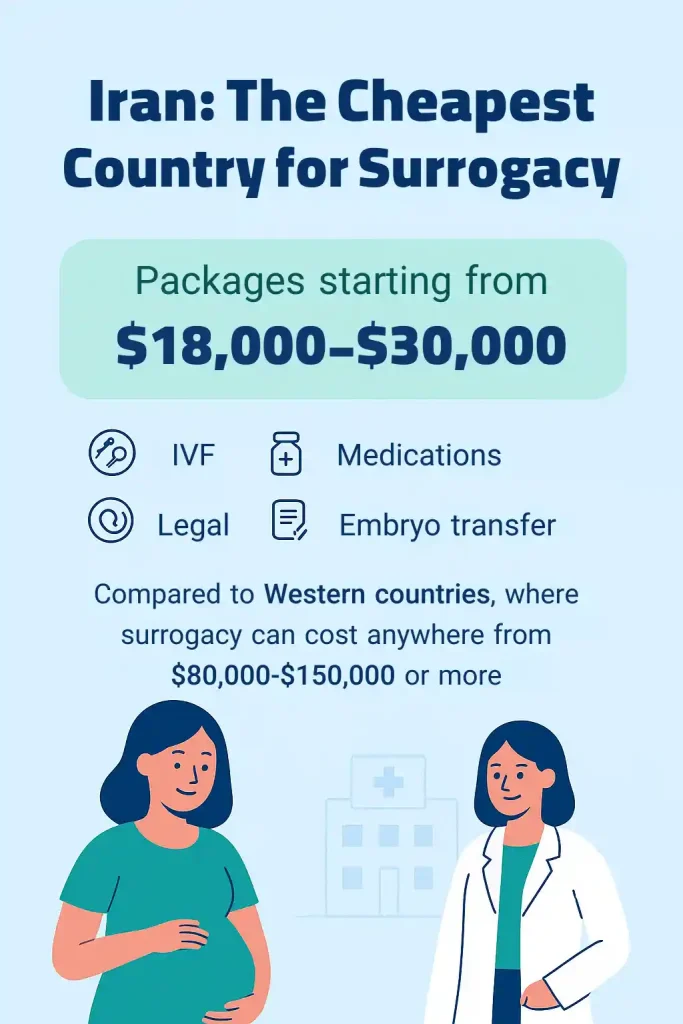
Iran is the cheapest country for surrogacy, with packages starting from $18,000 up to $30,000, including IVF, medications, embryo transfer, and legal contracts. Compared to Western countries, where surrogacy can cost anywhere from $80,000 to $150,000 or more, Iran offers a significantly more affordable option without compromising on medical quality or legal support.
Surrogacy in Mexico offers a flexible alternative for cross-border surrogacy, particularly for North Americans due to its proximity.
As one of the cheapest and most reliable options for overseas surrogacy, Georgia attracts many international parents.
Surrogacy in Colombia is now considered one of the most affordable and reliable options for international intended parents.
Greece provides a European option for international surrogacy, blending affordability with regulatory oversight.

For ultra-affordable surrogacy abroad, Kyrgyzstan stands out as an emerging destination. According to Kyrgyzstan surrogacy law for foreigners in 2025, the process is regulated with automatic parental recognition, making it legally secure for international intended parents
As of 2025, Kyrgyzstan allows and regulates surrogacy for both citizens and foreigners under its 2024 health law and government resolution. Foreigners must have legal residence in the country and valid medical reasons (like infertility) to qualify. A notarized agreement between the parents, surrogate, and clinic is required, and the pregnancy must be managed in a licensed medical center. Surrogates must be 20–40 years old, already have a child, and be medically and psychologically fit. The baby’s birth is officially registered, though citizenship depends on the parents’ home countries.
Canada serves as a premium yet altruistic-focused choice for surrogacy in other countries.
The UAE is emerging as a modern destination for surrogacy in other countries, following recent legalizations that make it accessible for international parents (Source).
Ghana has become a promising option for affordable surrogacy abroad, with clear legal frameworks supporting international intended parents (Source).
Nigeria is gaining traction as an emerging hub for surrogacy in other countries, particularly in Africa, though it operates in a legal gray area (Source).
While the above options are currently viable, some destinations were once popular for affordable surrogacy abroad but have become restricted. For example, surrogacy in Ukraine was a go-to choice for its low costs ($40,000–$65,000 USD) and legal clarity, but ongoing geopolitical conflicts have made travel and stability challenging, effectively limiting access. Similarly, surrogacy in India was affordable and widely used in the past, but since 2021, it’s been banned for foreigners, restricting it to Indian citizens only. These examples highlight how regulations can change, underscoring the need for up-to-date research.
To help you compare options at a glance, here’s a summary table of key factors for surrogacy in other countries:
| Country | Cost Range (USD) | Best For | Legal Status |
|---|---|---|---|
| United States | $100,000–$200,000 | All family types seeking premium care | Legal in select states (commercial/altruistic) |
| Georgia | $40,000–$80,000 | Cost-conscious heterosexual couples | Fully legal and regulated |
| Mexico | $50,000–$75,000 | Diverse families needing inclusivity | State-regulated, de facto allowed |
| Colombia | $50,000–$80,000 | LGBTQ+ and singles | De facto allowed with court approval |
| Greece | $70,000–$100,000 | Europeans preferring court security | Regulated with court approval |
| Kyrgyzstan | $34,000–$51,000 | Non-traditional families on a budget | Regulated with automatic recognition |
| Canada | $70,000–$90,000 | Ethically focused LGBTQ+ couples | Altruistic only, federally regulated |
| Iran | $14,000–$30,000 | Budget-focused heterosexual couples | Legal under Islamic laws |
Surrogacy in other countries opens doors to parenthood that might otherwise remain closed, offering a range of options from budget-friendly Eastern European and Middle Eastern hubs to inclusive Latin American destinations. Each country has its unique blend of legal frameworks, costs, and features, so weigh factors like your family structure, budget, travel feasibility, and ethical considerations. Ultimately, the choice is yours—select the option that best aligns with your personal preferences and circumstances. If you’re considering surrogacy in other countries but unsure where to begin, consult with an international surrogacy agency to compare programs and secure legal guidance. We recommend partnering with reputable agencies, consulting international family law experts, and staying updated on any legal changes to ensure a smooth journey.